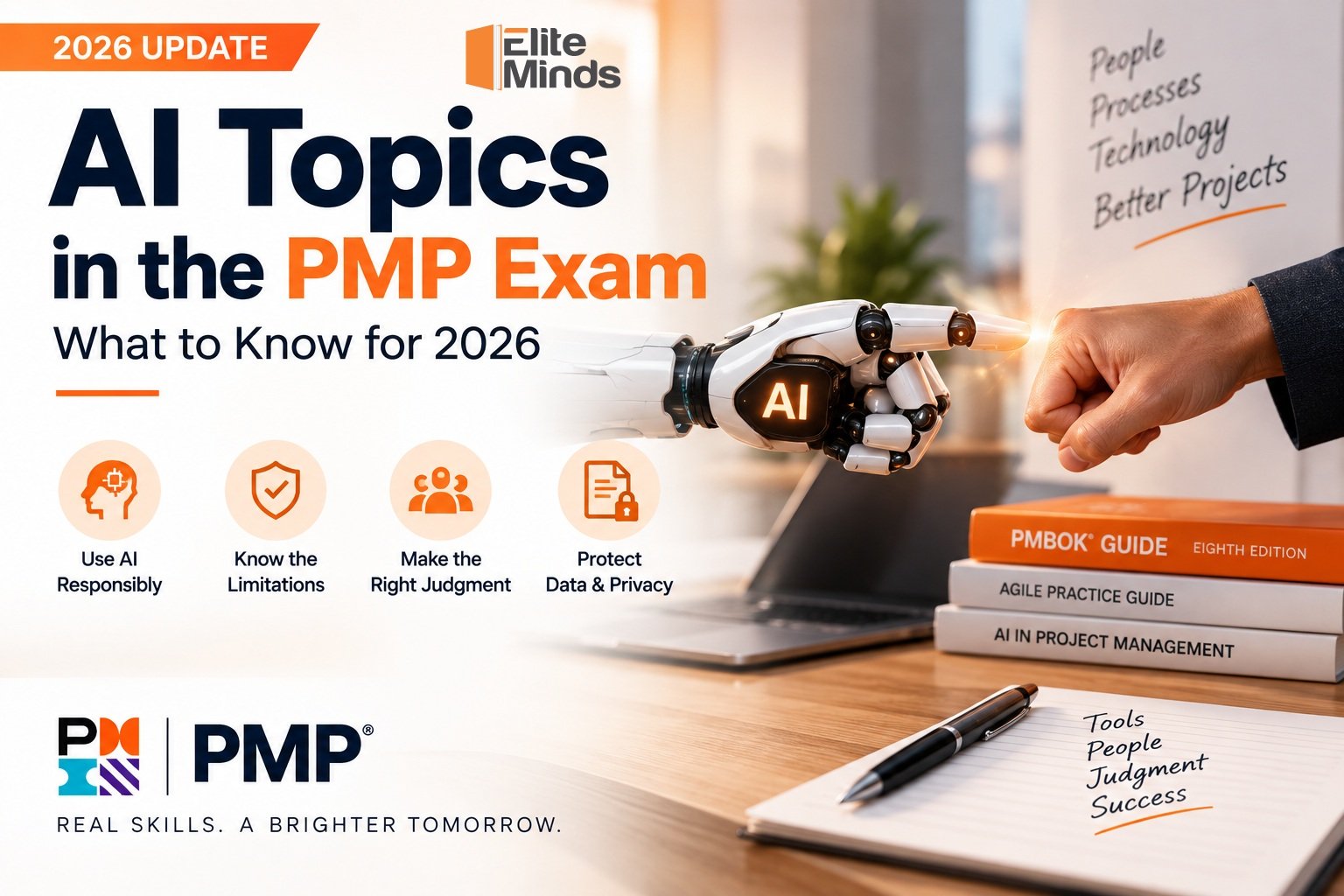
Starting from July 9, 2026, the new PMP exam includes scenario based questions that involve AI tools in project management. It is worth being precise about what that means, because it is widely overstated online. In PMI's 2026 Examination Content Outline, the phrase artificial intelligence appears exactly once, in the introduction, where PMI names AI and sustainability as trends it studied when updating the exam. There is no AI domain, no AI task, and no AI enabler. In short, AI is context on the exam, not content.
PMI is not testing whether you know a specific AI tool or how to write prompts. It is testing whether you can use AI tools responsibly as a professional project manager, recognize their limits, and make the judgment calls AI cannot make for you, the decisions involving accountability, ethics, stakeholder trust, and context a model does not have. This guide on AI topics in the PMP exam covers how AI actually appears, what PMI does not test, and how to prepare. The main thing you need to keep in mind is that the project manager remains accountable for all AI tools outputs and recommendations.
To better understand how AI may feature in the 2026 PMP exam, watch this overview of how AI-related scenarios are framed and what candidates should focus on when preparing.
What the ECO actually says about AI. AI is named once, in the outline's introduction, as one of the trends PMI used as an input to its Job Task Analysis. It is not a domain, task, or enabler. A scenario may describe a project that uses AI, much as a question might reference a dashboard, but the question still tests your decision as the project manager.
Why PMI referenced AI in the update
PMI updates the exam based on a Job Task Analysis, which is research into what practicing project managers actually do. AI tools have become part of daily project management work, from drafting status reports to flagging schedule risk and summarizing stakeholder feedback. As a project manager, the proper use of AI tools should help you shift your focus from admin work to more strategic work. PMI used that trend as one input when shaping the 2026 outline, which is why AI shows up as a realistic scenario backdrop rather than as a new subject to memorize. For the full context of the update, see our New PMP Exam 2026: Complete Guide to the July Changes.
How AI actually appears on the exam
Because AI is context rather than content, questions that involve AI are situational based, the same style as the majority of the PMP exam questions. You are given a scenario and asked what a professional project manager should do, and the AI element is simply part of the situation. The judgment the question tests is what matters, and it is the same judgment the PMP has always rewarded. The themes below describe the kind of judgment an AI-flavored scenario is likely to test.
Using AI tools responsibly
Scenarios can test whether you understand appropriate use, meaning using AI to accelerate drafting or analysis while keeping the project management team accountable for the final decision, rather than treating AI output as a finished answer. The proposed use of AI tools in day to day life includes using it for estimating and forecasting, risk identification, backlog refinement, data reporting and dashboards.
Illustrative example. A project manager uses an AI tool to draft a risk register for a new project. The best next action for the project manager is to review and validate the AI-generated risks against the actual project context, not to publish the draft as-is. Keep in mind, you remain accountable for AI outputs.
AI can help project managers prepare estimates, identify potential risks, and draft status reports. The important step is to validate these outputs against the project's actual context before relying on them. This video explores these practical applications and the importance of human review.
Recognizing AI's limitations
AI tools can produce confident-sounding output that is inaccurate, outdated, or missing project-specific context. A scenario can test whether you catch this rather than accept AI output uncritically, particularly where an error would have real consequences for the project or its stakeholders.
Judgment calls AI cannot make
Some decisions require weighing organizational politics, team morale, ethical considerations, or stakeholder relationships, judgment that depends on context and accountability an AI tool does not have. A scenario can test whether you recognize when a decision needs a human, not a tool.
Illustrative example. An AI tool recommends removing a team member from a project based on a productivity analysis results of this specific team member. In this scenario, the project manager's first action is for the project manager to exercise their own judgment and have a direct conversation with the team member, not to act on the AI recommendation alone.
Data privacy and confidentiality
A scenario can test awareness that project data, especially sensitive stakeholder, financial, or personnel information, should not be entered into AI tools without considering organizational policy and confidentiality obligations. That is a specific question in the real PMP exam.
AI governance involves more than protecting sensitive information. Project managers also need to recognize potential hallucinations and bias, validate AI-generated information, and follow organizational policies when using AI tools. This video explores these key risks and responsible AI use in project management.
Transparency with stakeholders
A scenario can test whether you would disclose AI involvement where it affects trust or decision-making, rather than presenting AI-assisted work as entirely your own analysis without context.
How AI may appear across the three domains
AI is not mapped to any domain in the ECO. The table below is an illustration of how AI context could appear within the existing domains, not a list of defined exam content. For the exam's actual domain weighting and task breakdown, see our PMP Exam Content Outline (ECO) 2026 guide.
| Domain | How AI may appear as context (illustrative, not defined ECO content) |
|---|---|
| People | Leading a team through AI-related change, addressing concerns about AI affecting roles, and modeling responsible use. |
| Process | Using AI to support planning, scheduling, or risk analysis while validating and owning the output. |
| Business Environment | Organizational AI policy, compliance, and data-handling considerations. |
What PMI does not test
- Specific AI products or vendors. The exam does not assume you use any particular tool.
- Prompt-writing technique. How well you can prompt an AI model is not assessed.
- Technical AI or machine-learning concepts. This is a project management exam, not a technical AI exam.
- AI coding or implementation. Building or configuring AI systems is out of scope.
If a practice question asks you to name a specific AI product or explain how a model works technically, that question is not representative of the real exam, the real PMP exam will never do.
How to prepare for AI-related scenarios
- Practice applied judgment, not memorization. These scenarios reward the same thinking as the rest of the exam.
- Assume AI assists, never decides. In every scenario, look for the answer that keeps a human accountable. Keeping this in mind, makes every AI question in the exam look very easy.
- Default to verification. When a scenario shows AI-generated output, the safe answer usually involves checking it, not accepting it.
- Watch for confidentiality cues. Scenario details about sensitive data are rarely incidental.
- Use a 2026-aligned simulator. Practicing realistic scenarios is more useful than reading about the topic alone.
Common mistakes
- Assuming these questions require technical AI knowledge. They do not.
- Picking answers where the project manager defers entirely to AI output. This is almost always wrong.
- Ignoring AI context because your current role does not use AI yet. Scenarios can still involve it.
- Treating every AI-flavored scenario the same way. Context, such as data sensitivity, stakeholder impact, and reversibility, changes the correct response.
- Practicing with an outdated simulator that has no AI-scenario coverage at all.
Conclusion
AI on the 2026 PMP exam is not a technical test, and it is not a large body of new content. It is scenario context that puts the exam's usual judgment test into a modern setting: can you use AI to support project work while staying accountable for the outcome, recognize where AI falls short, and know which decisions still need a human. Prepare by practicing scenario-based questions, not by studying AI products or tools.
For structured preparation, see our PMP Exam Prep Course. To practice realistic scenarios, try our PMP Exam Simulator. For the full picture of what changed.
Frequently asked questions
No. The exam tests judgment about using AI responsibly, not knowledge of any specific product.
No. AI is not a domain, task, or enabler. It appears only as scenario context within the existing three domains.
There is no fixed AI percentage. AI is not a content area. It appears as context inside ordinary scenario questions.
No. This is a project management exam. Technical AI concepts are out of scope.
Look for the answer that keeps a human accountable, verifies AI output, and considers context AI does not have, rather than the answer that accepts AI output uncritically.
No. The scenarios test judgment and awareness, not hands-on tool experience. Understanding the principles in this guide is enough.
Indirectly, through scenarios involving responsible use, transparency, and data handling, rather than abstract ethical theory.
No. AI is named only once in the outline, as context, while sustainability appears more explicitly across several enablers.