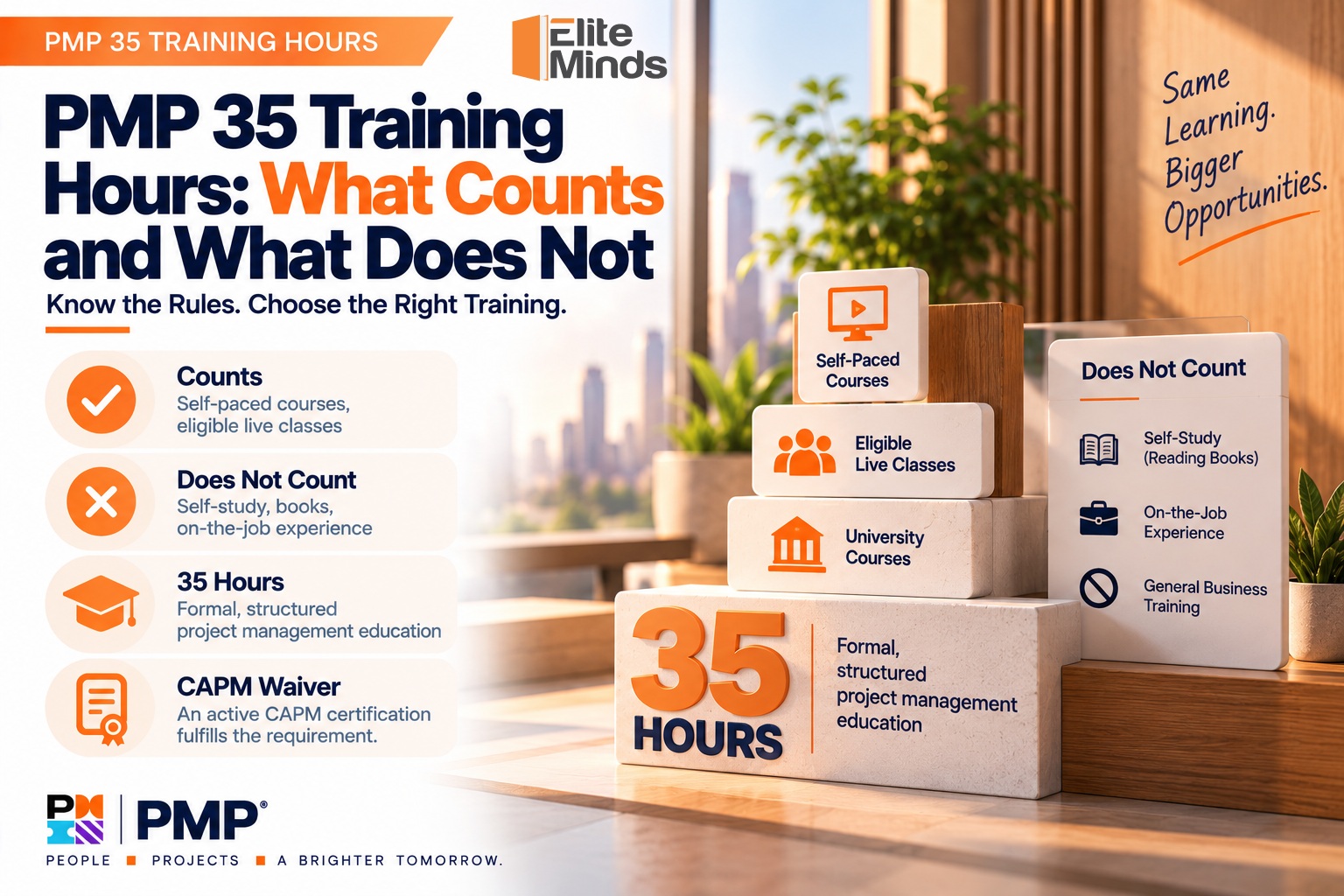
The PMP 35 training hours, also called the 35 contact hours, are formal, structured project management education that you complete before you apply. Self-paced courses from any reputable provider count. You can combine hours from several courses, and an active CAPM certification waives the requirement.
One rule changes soon. From December 1, 2026, live instructor-led classes, in person or online, count only if a PMI Authorized Training Partner, an eligible accredited higher-education program, or a China Registered Education Provider delivers them. Reading books on your own and on-the-job experience never count toward the 35 hours. This guide explains what qualifies and how to document it.
The December 1, 2026 rule for live training
What is changing. The PMP education requirement is still 35 hours. What changes is which providers can deliver live, instructor-led training. Self-paced, on-demand courses are not affected. The rule applies based on when you complete the training, so confirm the current rules on PMI's PMP certification page before you enroll in a live class.
| Type of training | Completed before December 1, 2026 | Completed from December 1, 2026 |
|---|---|---|
| Self-paced, on-demand course from any reputable provider | Counts | Counts |
| Live class from a PMI Authorized Training Partner (ATP) | Counts | Counts |
| Live class from an eligible accredited higher-education program (including PMI GAC programs) or a China Registered Education Provider | Counts | Counts |
| Live class from any other provider, such as a non-ATP school or an internal employer workshop | Counts if it meets the criteria | Does not count |
If you plan to take a live class, ask the provider for its PMI Authorized Training Partner status, and check it in PMI's directory. A badge on a website is not enough.
What counts as PMP training hours
A course counts when it is formal and structured. That means it has a defined outline, clear learning objectives, and a record that you completed it, such as a certificate. Self-paced online courses, university courses, and live classes from an eligible provider can all qualify.
The course title does not need to say "project management." The key point is the content: it should cover project management topics aligned with the exam's three domains, People, Process, and Business Environment. If a broader course covers project management only in part, count only those hours. See our PMP Exam Content Outline (ECO) guide for the domains and tasks your training should match.
Combining hours from different sources
You do not need one course that covers all 35 hours. Each source only needs to meet the criteria above.
Example: You completed a university project management module worth 20 hours. You then take a self-paced online course and count 15 hours from it. 20 plus 15 gives you the 35 hours. If the university module was a live class completed after December 1, 2026, check that the university is an eligible accredited program.
What does not count
- Self-study without a structured course, such as reading the PMBOK Guide or a prep book on your own.
- On-the-job project experience. Leading projects is a separate requirement, measured in months. See our PMP eligibility guide.
- The parts of a broader course that are not about project management.
- General business or soft-skills training that does not address project management.
- From December 1, 2026, live classes from providers that are not on PMI's eligible list.
The CAPM waiver
If you hold an active Certified Associate in Project Management (CAPM) certification, it fulfills the 35-hour requirement. You do not need to complete separate training hours to apply for the PMP.
PMP contact hours vs PDUs
| Contact hours | PDUs | |
|---|---|---|
| Purpose | Qualify to apply for the PMP exam | Keep your PMP active after you pass |
| Amount | 35 hours, one time | 60 PDUs every 3 years |
| When | Before you apply | After you are certified |
Both are counted in hours of learning, so people often confuse them. The 35 contact hours get you to the exam. PDUs keep your certification active afterward. Be careful with course labels: a course advertised as "35 PDUs" is not automatically valid for the 35 contact hours. Ask yourself whether the course is designed as PMP exam preparation education, not only as continuing education.
Do you need a PMI Authorized Training Partner?
It depends on the format. For self-paced courses, no. A self-paced course from any reputable provider can count, before and after December 1, 2026. For live, instructor-led classes completed from December 1, 2026, yes, or another eligible provider such as an accredited higher-education program.
Our PMP Exam Prep Course is self-paced, so its 35 hours are not affected by the December 1 change.
How to document your hours
- Keep the certificate of completion for every course you count.
- Record the provider, course name, number of hours, dates, and topics for each course.
- For live classes, note the provider's eligibility status at the time you completed the course.
- List each course separately in your PMI application.
- Keep all records. If PMI selects your application for audit, you will need to show proof of your training.
Your next step
To complete all 35 hours in one place, see our self-paced PMP Exam Prep Course.
Frequently asked questions
35 contact hours of formal project management education, completed before you apply, or an active CAPM certification.
No. You can combine hours from several courses, as long as each one meets the criteria.
PMI does not approve individual courses for the 35 hours. For live, instructor-led training completed from December 1, 2026, PMI controls which providers are eligible: Authorized Training Partners, eligible accredited higher-education programs, and China Registered Education Providers. Self-paced courses from any reputable provider can count.
The number of hours did not change. From December 1, 2026, live instructor-led training must come from an eligible provider. Self-paced training is not affected.
Yes. An active CAPM certification fulfills the training requirement.
No. Reading on your own without a structured course does not meet the requirement.
No. Training hours you completed in the past can still count, as long as they meet the criteria.
You provide proof of your training, such as certificates of completion, along with proof of your education and experience.