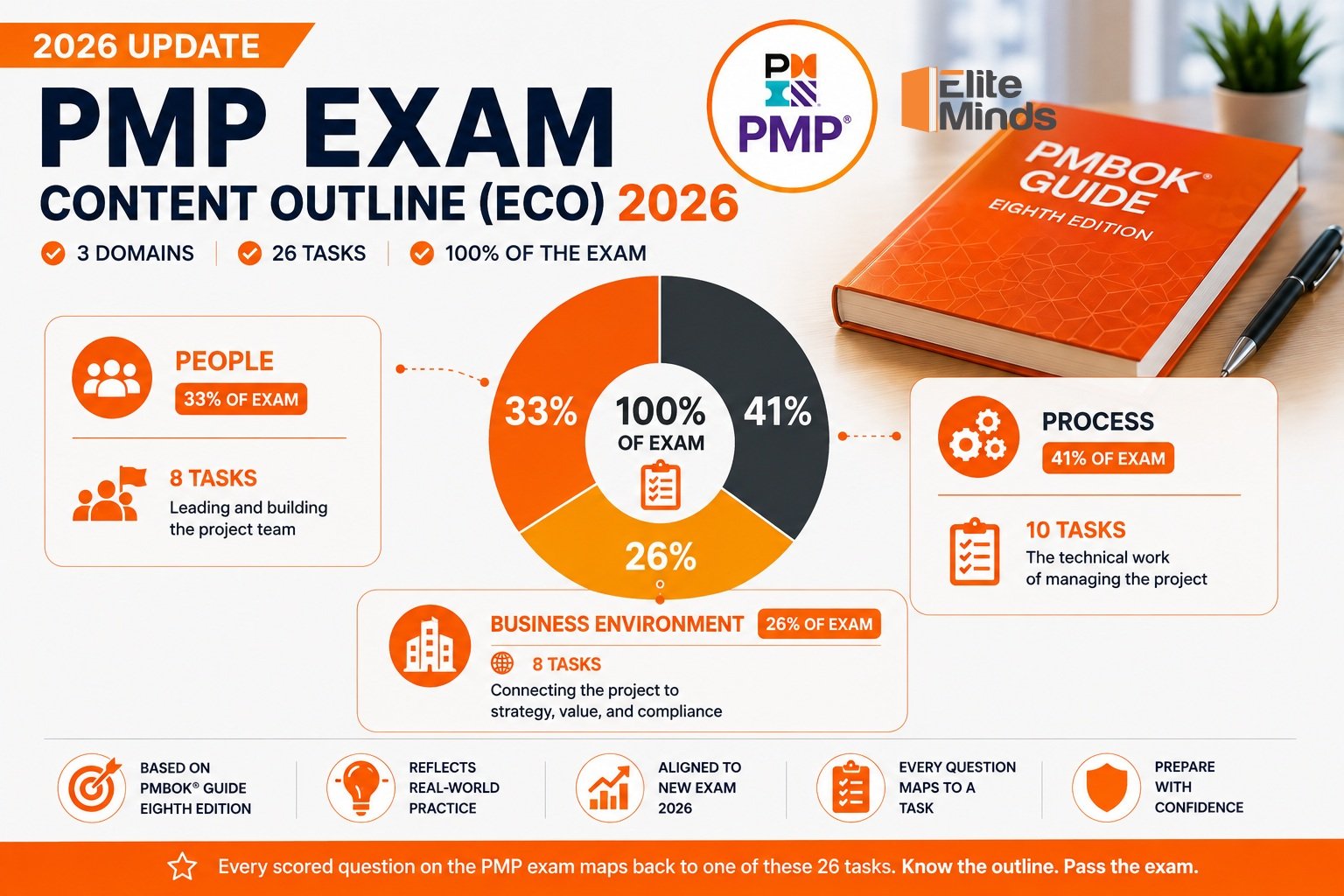
The PMP Examination Content Outline (ECO) is PMI's official blueprint for the exam. It lists everything the exam can test, grouped into three domains: People, Process, and Business Environment. And broken down into 26 tasks. The current version took effect on July 9, 2026, and it rebalanced the domain weighting to People 33%, Process 41%, and Business Environment 26%. Every scored question on the exam maps back to a task in this document, which is why the ECO, not the PMBOK Guide, is the real map of what you need to prepare.
Want the story of what changed in July 2026? See our complete guide to the new 2026 PMP exam. For timing, breaks, and question types, see the PMP exam format 2026 guide.
What is the PMP Examination Content Outline?
The Examination Content Outline is PMI's official description of what the PMP exam covers. It is not a textbook and it does not teach concepts. Think of it as the exam's syllabus a structured list of what will be tested, organized into domains, tasks, and enablers. PMI builds it from research into what project managers actually do on the job, and it revises the outline every few years so the exam keeps pace with real practice. The version in effect today was published in November 2025 and went live on July 9, 2026.
The three domains and their 2026 weighting
The exam is organized into three domains, each representing a major area of a project manager's responsibility. The 2026 outline kept the three domains but changed how much each one is worth.
| Domain | 2026 weight | Tasks | What it covers |
|---|---|---|---|
| People | 33% | 8 | Leading and building the project team |
| Process | 41% | 10 | The technical work of managing the project |
| Business Environment | 26% | 8 | Connecting the project to strategy, value, and compliance |
| Total | 100% | 26 | Every scored question maps to one of these tasks |
The headline change is Business Environment, which rose from its previous 8% to 26% due to its importance in real life project management. Topics such as governance, compliance, and risk now sit in this domain, so it carries far more questions than it used to. For the full before-and-after, see our 2021 vs 2026 PMP exam comparison.
Tasks and enablers explained
Each domain is divided into tasks, and there are 26 tasks in total across the three domains. A task is something a project manager is expected to do, such as building a team or managing risk. Under each task sit enablers, which are short examples that show what the task looks like in practice.
Enablers are illustrative rather than a complete checklist, so the exam will not ask you to recite them. What matters is that you can apply the idea behind each task to a realistic scenario. The 2026 outline consolidated the old 35 tasks down to 26, mostly by grouping related work together rather than by removing content.
Predictive, agile, and hybrid approaches
The exam does not stick to one way of running projects. About 40% of the questions reflect predictive, or traditional project management approaches, and about 60% reflect agile and hybrid approaches. These are spread across all three domains rather than sitting in a section of their own, so you need to be comfortable moving between them. In the recent changes in the PMP exam in 2026, the agile and hybrid approaches shared increased significantly.
How the ECO maps to exam questions
Of the 180 questions on the exam, 170 are scored, and PMI distributes them roughly in line with the domain weights. A domain weighted at 41% will account for close to 41% of your scored questions. That is what makes the weighting so useful for planning, because it tells you where the marks are. For the full format, including timing, breaks, and question types, see our PMP exam format 2026 guide.
How to use the ECO to prepare
- Study in proportion to the weights. Process and People still carry the most questions, but Business Environment now sits at 26%, so give it real attention instead of treating it as an afterthought.
- Work through each task and ask whether you could answer a scenario question about it. Use the enablers to spot gaps in your understanding.
- Pair the ECO with a current, PMBOK 8-aligned resource for the underlying concepts. Our PMP syllabus overview covers what to study.
- Practice with a 2026-updated PMP exam simulator so the domain balance and question styles feel familiar before test day.
- Build the plan around your own timeline with our PMP study plan.
- For structured, instructor-led guidance mapped directly to the 2026 outline, see our PMP exam prep course.
Where AI and sustainability fit
The 2026 update brought newer themes into the exam, including artificial intelligence and sustainability. These show up mainly through the Business Environment domain and its enablers. We cover both in dedicated guides: AI topics in the new PMP exam and sustainability questions in the PMP exam.
ECO vs the PMBOK Guide
People often confuse the ECO with the PMBOK Guide, but they are different documents with different jobs. The ECO defines what is tested and how much each area is worth. The PMBOK Guide explains the concepts and practices behind those topics. PMI writes exam questions from the ECO, not from PMBOK chapters, so the outline should drive your preparation strategy while the PMBOK Guide and other references build your understanding. Our PMP syllabus overview covers the study content itself.
Frequently asked questions
It is PMI's official blueprint for the PMP exam, listing the domains, tasks, and enablers that every exam question is based on.
It was implemented on the PMP exam from July 09, 2026.
People 33%, Process 41%, and Business Environment 26%.
26 tasks in total, spread across the three domains. The previous outline had 35.
Illustrative examples under each task that show what the task involves. They are not an exhaustive list, and you do not need to memorize them.
No. The ECO defines what is tested. The PMBOK Guide explains the concepts. Exam questions come from the ECO.