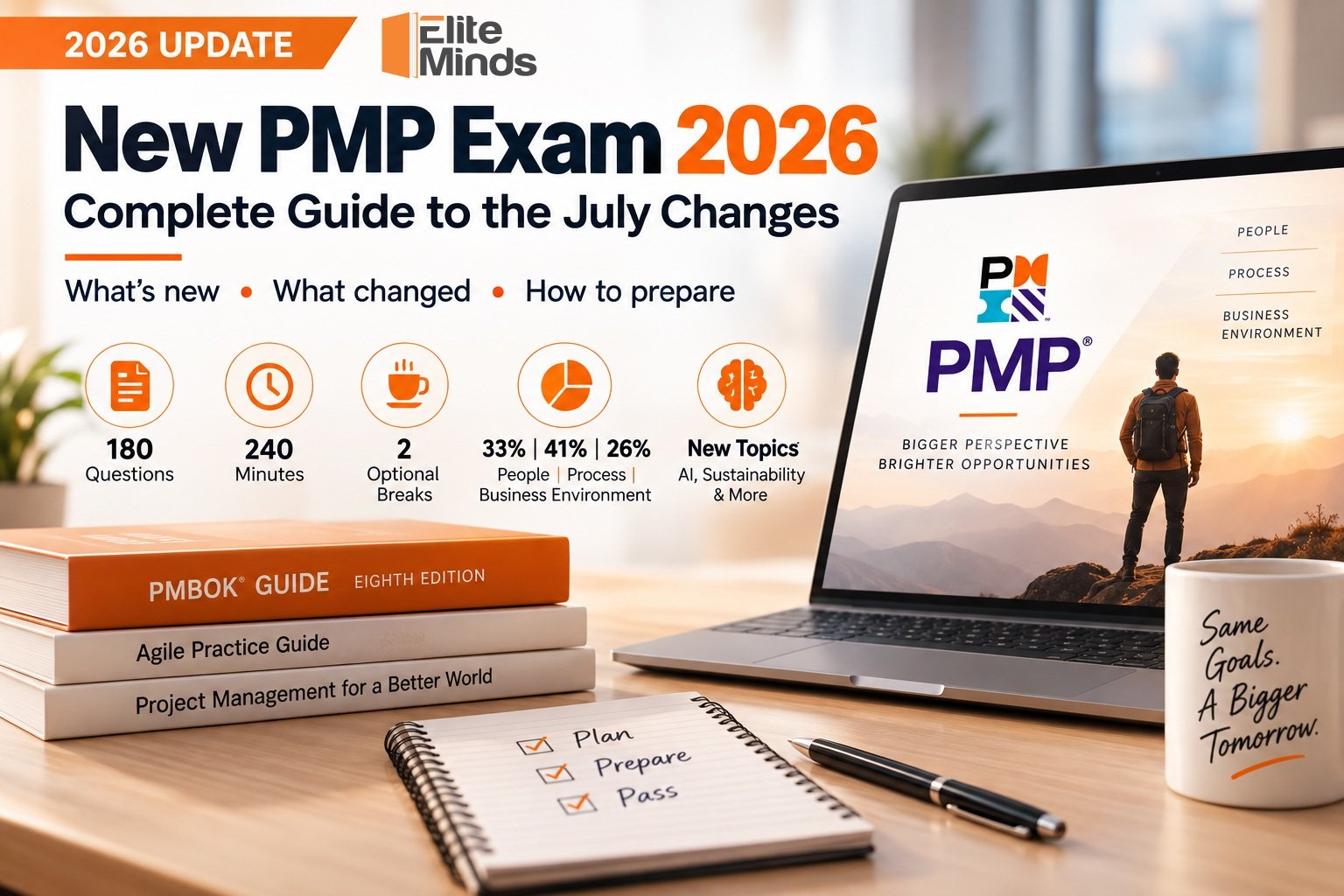
Starting July 09, 2026, the PMP exam officially changed. The Project Management Institute (PMI) introduced a significant update to its flagship certification exam over the past few years. The exam is shifting now toward a new version, rebalanced domain weights, revised terminology, expanded content areas such as AI in project management, sustainability, and governance, and it is now heavily scenario-based questions exam.
If you have just started preparing for this milestone, or you are planning for it soon, or you are transitioning from the old version, it is very important to read this guide, to understand what are the key changes, what remained the same, and what should you do to prepare for this new PMP exam 2026.
In this complete guide, I will break down the new PMP exam 2026 structure, identify and list the PMP exam changes 2026, explain the new topics covered, how the exam is structured based on the PMBOK 7th and 8th versions, and recommend for you the plan to approach your preparation journey for the new PMP exam 2026 and make sure you pass it from the first trial.
Quick facts
| Element | 2026 exam |
|---|---|
|
Launch date |
July 9, 2026 |
|
Questions |
180 (170 scored, 10 unscored pretest) |
|
Duration |
240 minutes, and two optional 10-minute breaks: the first after the case study section and the second roughly midway through independent questions. |
|
Domains & Weighting |
People 33%, Process 41%, Business Environment 26% |
|
PMBOK edition |
PMBOK Guide, Eighth Edition (published November 2025) |
|
ECO version |
July 2026 Examination Content Outline |
|
AI in PM |
New scenario content on using AI responsibly in project work |
|
Sustainability |
New scenario content on environmental and social project impact |
What's New in the PMP Exam?
In the table below, I am listing the key changes that took place in the PMP July 2026 update.
| Key Change | Before (2021) | After (2026) | Why does it matter? |
|---|---|---|---|
|
Exam Domains Weighting |
People (42%), Process (50%), and Business Environment (8%) | People (33%), Process (41%), and Business Environment (26%) | Business environment domain weight jumped from 8% to 26%. Topics like Strategy, value, governance and compliance carry real exam weight now. |
|
Exam Question Types |
Multiple choice, multiple response, drag and drop, fill in blank | The 2021 types, plus case study questions, are introduced now. | You need to practice such exam questions in your simulators. A one pager cast study is provided, and 3-5 questions about it. |
|
Emerging topics |
---- | AI in project management, ESG, sustainability, value delivery, and data driven project management. | These topics are being tested in the new PMP exam format in the form of situational questions. |
|
Exam Timing & breaks |
230 minutes, and 2 breaks after Q60 and Q120. | 240 minutes, and two optional 10-minute breaks: the first after the case study section and the second roughly midway through independent questions. | Be familiar with the new exam format. No surprises on the exam day. |
|
Exam study materials |
PMBOK 6th and 7th editions, and Agile practice guide. | PMP ECO 2026 is the main reference, in addition to the PMBOK 8th edition, and the Agile practice guide. | Major change in your preparation journey, and you need to follow the new references. |
The new PMP exam 2026 had changed dramatically, if I want to conclude the changes that took place. The PMBOK 8th edition returned 40 non-prescriptive processes and 5 process groups that the PMBOK 7th retired. Also, PMBOK 8th introduced 6 refined actionable principles instead of the 12 principles that PMBOK 7th introduced, in addition to multiple changes across the book. Why is this important? Because that means a whole change in the PMP mindset, and different approach for the exam preparation.
The sections below introduce each change at a high level. Full detail lives in the dedicated article for each topic. For timing and question split, see our PMP Exam Format 2026 guide, and for the before-and-after, see the Old vs New PMP Exam comparison.
AI in Project Management
Artificial intelligence (AI) is changing how project management takes place in 2026. Multiple AI tools have become part of our day-to-day work as project managers. The beauty of AI tools that they can digest volumes no normal human can, from historical risk registers to full assessment of vendors performance. When it comes to administration, the administration layer for project managers compresses from hours to minutes.
One important thing to keep in mind is as a professional project manager, accountability remains with the project manager, AI tools should help you as the project manager shift your focus to become more strategic, but it should never absorb your responsibility. PMI responded to these changes through introducing appendix X3 in the PMBOK 8th edition, covering AI in project management, use cases of how it can be used in estimating, risk identification, and other project management areas, in addition to the human limits and AI governance. For the new PMP exam changes 2026, you should expect few situational questions around this topic. Read our complete AI topics in the PMP exam guide for the full breakdown.
Sustainability
The PMBOK 8th edition made sustainability as a principle that is being integrated across all project performance domains. In the context of project management, sustainability widens what is being optimized in projects: beyond scope, schedule, and budget, it extends to people, planet, and long-term organizational value. For the new PMP exam 2026, you should expect scenario questions where the sustainable option competes with low cost or fast option. PMI introduced the Environment, Social, and Governance (ESG) concept heavily in the PMBOK 8th edition as well, where ESG criteria shape the project requirements and scope. See our Sustainability Questions in the PMP Exam guide for scenario questions.
Value Delivery
PMBOK 8th edition complemented what the PMBOK 7th edition introduced as the system for value delivery. That is clear of the new definition of a project: A temporary initiative in a unique context undertaken to create value. The PMBOK 8th shift, outcomes value, not just outputs and artifacts, and assumes that project managers are mandated to deliver value inside the organization's system for value delivery. PMI Boldy explains this concept in the new PMBOK because projects are investments, so the value created by the project should be worth the investment, effort, and risk. Something important to keep in mind during the PMP exam, value is checked on regular basis throughout the project life cycle, not only at the early phase of the project. The business case and benefits realization plan should stay alive throughout the project, and performance should be measured against them at every stage gate of the project. For the PMP exam questions, value delivery system questions keeps appearing in the PMP exam constantly, and you need to understand how this system works in real life scenarios.
Business Environment
One of the major changes of the PMP exam changes 2026 is the weight of the business environment exam domain. It is now 26% vs 8% for the old PMP exam, which means around 47 questions of your PMP exam will come from the 8 tasks related to this domain. Key topics under this domain include change management, risk, governance and compliance, external environment, and continuous improvement. For more information about this domain and how the PMP exam will test it, see the complete PMP Exam Content Outline (ECO) 2026 guide for the tasks, enablers, and weighting breakdown.
Why PMI Updated the PMP Exam?
I am sure that is a question that came to your mind, why did PMI do the PMP July 2026 update? As per the PMI publications, comprehensive research was done in 2023 that included 48,000 data points, and 88% out of them wanted to make the proposed project management principles in the PMBOK 7th version more actionable and easier to apply, that is why the PMBOK 8th version maintained the principles-based standard, but the 12 previous ones where consolidated into 6 more actionable ones. One of the key findings of this research was that around 79% wanted process groups and processes back into the PMBOK 8th guide.
This was implemented and it is one of the key PMP July 2026 updates, returning the process groups as focus areas, and having back 40 processes.
Also, given the evolution of Artificial Intelligence (AI) over the last 5 years and given that most of the project managers are utilizing it today in their day-to-day job, the PMP July 2026 update includes AI in project management, and it is covered in the appendix of the PMBOK 8th, and you should expect questions about it in the new PMP exam format.
In addition to all recent trends such as digital transformation, environment and sustainability, focusing on value delivered by the projects and how the deliverables are being sustained, all these reasons drove the PMI to launch the new PMP exam.
What does that mean for you? It means that today you will study PMP exam prep material that is more updated and fits the current modern project management environments. It will ease applying what you learn to your day-to-day job, which gives a lot of credit to the PMI because of the PMP July 2026 update.
The Three Exam Domains (High-Level Overview)
Think about the PMP ECO 2026 as the official blueprint the PMI builds your exam from. It is built around 3 main domains: People, Process, and Business Environment. The responsibilities of the project manager inside each domain are represented by the tasks of the PMP ECO 2026, and for every task, there are groups of enablers which are illustrative examples of the work inside each task.
Why is this important for you? Because every question of the PMP exam is written based on a task and its enablers, then wrapped up with a scenario.
People (33%)
Around 59 of your 180 questions will be from this domain, covering its eight tasks. Focusing on building and forming teams, leadership styles, stakeholders' engagement, conflict management, and communication. Most of these questions will be scenario-based testing behavior and not definitions.
Process (41%)
Around 74 of your 180 questions will be from this domain, the biggest chunk, covering its ten tasks. Focusing on initiating, planning, executing, monitoring, and closing focus areas. In addition to the performance domains of the PMBOK 8th edition. More than half of these domain questions will be in Agile and Hybrid context.
Business Environment (26%)
Around 47 of your 180 questions will be from this domain, covering its eight tasks. Focusing on strategy and value, continuous improvement, change management, organizational change, governance, and compliance.
Read the complete PMP Exam Content Outline (ECO) 2026 guide for a detailed breakdown.
PMBOK 8th and the PMP Exam
PMP exam candidates always confuse between the PMP Exam Content Outline, and the PMBOK. As explained in the previous section of this blog, the PMP ECO 2026 as the official blueprint the PMI builds your exam from. Every question in the PMP exam can be linked to one of the 26 tasks. However, the PMBOK 8th edition is the main reference guide you need to study from to understand the concepts behind the exam questions. The PMP exam questions writers use the ECO to write the exam questions, and not the PMBOK 8th edition guide.
The new PMBOK 8th edition is structured around 6 actionable project management principles, 7 performance domains, 5 focus areas, and 40 processes. In addition to key topics covered in the appendix such as AI in project management, procurement, and Project Management Offices (PMOs).
Read our complete PMBOK 8 and the PMP Exam guide for what changed and how to study it.
New Questions Formats
The 2026 exam uses several question formats, built to test how you apply project management judgment rather than how much you can memorize:
- Case or scenario set (new for 2026): an extended, multi-paragraph case study followed by 3–5 linked questions.
- Visual-based (new for 2026): a question built around visuals such as information radiators and dashboards.
- Multiple choice: select the best option from four choices.
- Multiple responses: more than one correct answer may exist; the question tells you how many to select (usually 2–3).
- Drag and drop: match choices presented in two columns.
- Hotspot: select a portion of a diagram to mark the correct answer.
- Pull-down list (fill in the blank): choose the correct answer from a drop-down list.
For definitions, examples, timing, and exam-day logistics, see our PMP Exam Format 2026 guide.
What didn't Change?
I am listing below a few bullet points for things that didn't change, just to assure you that if you have solid project management practices understanding, you are not starting from scratch, you are just updating your knowledge.
- The credential itself didn't change. It is the Project Management Professional (PMP) issued by the Project Management Institute (PMI).
- Number of questions in the PMP exam remains 180 questions.
- Eligibility requirements and application process remain the same.
- The exam domains were not touched (People, Process, and Business Environment), the weighting and questions share was updated.
- Agile and Hybrid development approaches still have +50% share of the exam questions.
- PMI Code of Ethics is still being tested with the same weight. (Easiest questions in the PMP exam)
- More than 90% of the PMP exam questions are still scenario-based, focusing on situational judgment rather than memorization.
Do you Need New Study Materials?
Short answer, yes! I have been helping candidates to pass the PMP exam since 2016, and trust me, this change that took place in July 2026 was the biggest one. Your PMP Exam Prep Course should be fully aligned with the PMP ECO 2026, and should be based on the PMBOK 8th edition, The Agile Practice guide, and few topics from the PMBOK 7th edition.
The PMP exam simulators you are using to prepare for the PMP exam should reflect the new domains weightings and should cover the newly introduced topics such as AI in project management, sustainability, ESG, data driven project management, and others. In addition to that, you should be well prepared through practicing the new exam question types, such as case-study linked questions, and visual based.
Using such preparation courses and exam simulators will make you 100% ready to pass the new PMP exam 2026 from your first attempt.
How to Prepare for the New Exam?
My recommendation below represents the high-level roadmap of how you should get ready for the new PMP exam 2026:
- Understand the key changes that took place. This guide is your starting point.
- Read and understand the PMP ECO 2026. See the PMP Exam Content Outline (ECO) 2026 for the full domain, task, and enabler breakdown.
- Watch our PMP exam prep course: 35 contact hours for PMI.
- Read the PMBOK 8th edition. See our PMP Syllabus 2026 guide.
- Build your study plan based on the time you can spare in preparation. See PMP Study Plan: 30, 60, and 90-Day Options.
Biggest Mistakes Candidates Make
- Using old preparation material, or courses that treat the new changes as additions or footnotes.
- Underestimation of the value of the business environment PMP exam domain. Topics like strategy and value, continuous improvement, and organizational changes are heavily tested now.
- Wasting time trying to memorize the ITTO of the 40 processes in the PMBOK 8th edition, remember that the real PMP exam relies on situational judgement.
- Focusing on topics related to predictive development approaches only. More than 50 percent of the new PMP exam questions are in Agile and Hybrid context.
- Not practicing high-quality updated PMP exam simulators in timely manner. Majority of candidates who fail the exam fail because of poor time management in the exam.
- Ignoring the newly added trending topics like AI in project management and sustainability.
Conclusion
If I want to conclude this guide in few points, keep the following points in mind:
(1) The weights of the exam domains changed dramatically, with the business environment domain weight tripling from 8% to 26%.
(2) Your new preparation materials should be fully aligned with the new PMP ECO 2026 and PMBOK 8th edition.
(3) Don't underestimate the importance of the newly introduced topics: AI in project management, value delivery, data driven project management, sustainability, and ESG.
(4) It is critical to use PMP exam simulators that include the new questions formats like case study and visual based.
For a detailed comparison of 2021 PMP ECO and 2026 PMP ECO, check our Old vs New PMP exam. To prepare for the new 2026 PMP exam with confidence, check our PMP exam prep course.
Frequently Asked Questions
The new PMP exam started on July 9, 2026.
Relearning project management is a big word. The PMP credential, leadership styles, core discipline, and the three PMP exam domain structure are unchanged. You need to update your exam PMP exam preparational materials and simulators and rebalance your study priorities to cover the newly introduced topics, not start over.
The answer to this question is subjective, and it varies from one person to another. In my opinion, it's not harder. It is more realistic and updated to reflect how project management practices are being applied in 2026.
As an optional read yes. However, your main study reference should be the PMBOK 8th edition. PMBOK 7th edition concepts still apply broadly, but the exam is now aligned to PMBOK 8. Topics like AI in project management, sustainability, data driven project management, and value delivery system are not covered in the PMBOK 7th edition.
Through situational questions about AI use cases of how it can be used in estimating, risk identification, backlog refinement and other project management areas, in addition to the human limits and AI governance, not through questions about specific AI software. Keep one thing in mind: the project manager remains accountable for AI tools outputs.
Of course. Around 60% of the exam questions reflect agile and hybrid development approaches, alongside predictive approaches.
Check our PMP Exam Format 2026 guide, linked above.
This guide introduces every change new and returning candidates need to know. If you studied under the 2021 outline and want a detailed side-by-side of exactly what to keep, update, or replace.
Start with the ECO and Syllabus to understand what is tested and what to study, then build a study plan around your target exam date and begin practicing with an updated simulator. Check this guide for a high-level preparation roadmap.
In addition to the previous exam question types, the PMI introduced case study questions and visual based. However, the exam is still heavily relying on multiple choice questions.
A definite no. Old PMP mock exams don't reflect the new weights of the PMP exam domains, and the tripled weight of the business environment domain. Also, they don't include questions around the newly introduced PMP exam topics such as AI in project management and sustainability.