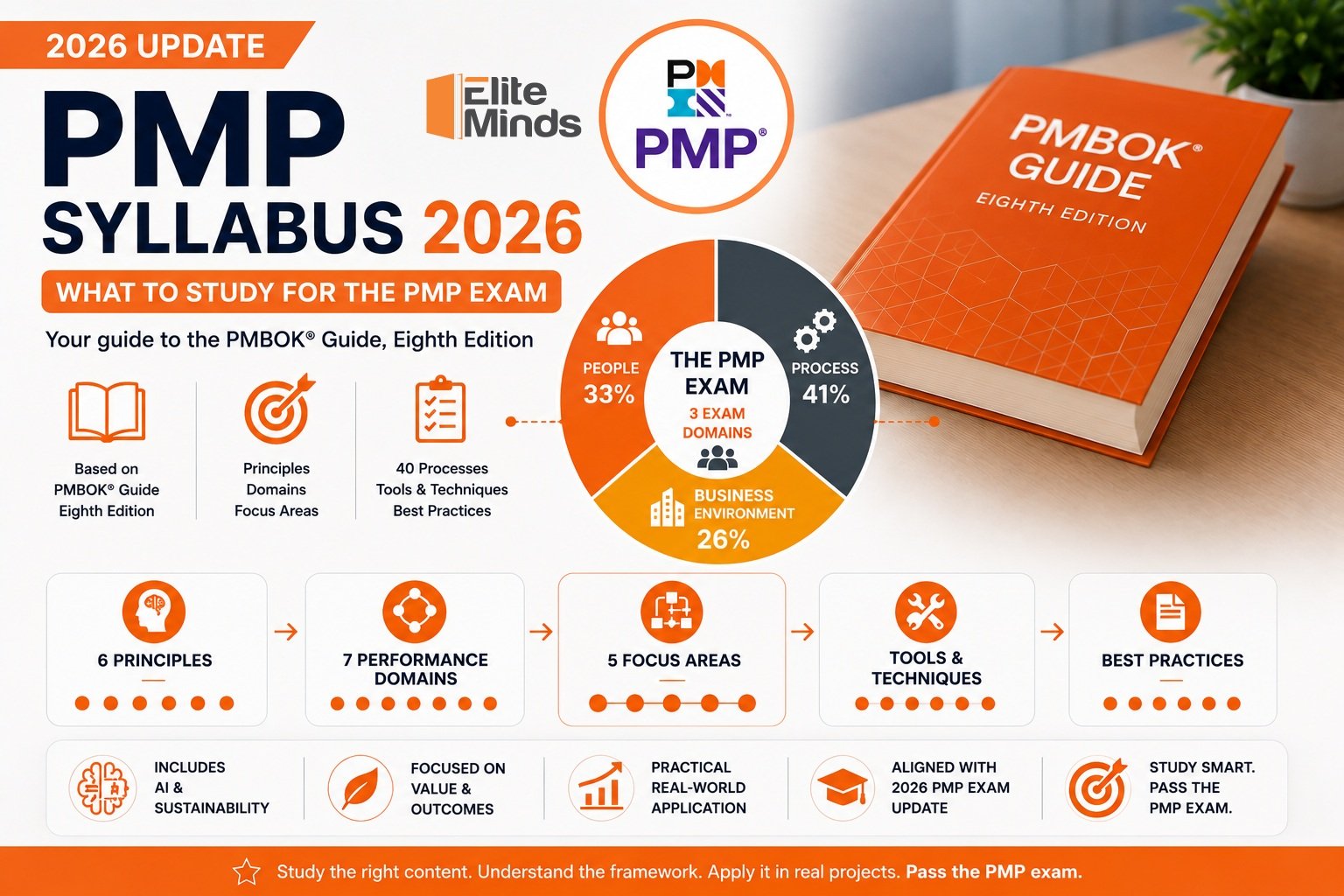
The PMP syllabus is the body of knowledge you study to pass the exam, and it is drawn mainly from PMI's PMBOK Guide, Eighth Edition, published in November 2025. PMBOK 8 organizes project management into six core principles, seven performance domains, and five focus areas that hold 40 practical processes, supported by best practices, tools and techniques. It replaces the older ten knowledge areas structure that earlier PMP material was built around. Keep one thing in mind throughout: the PMBOK Guide tells you what to study, while the Examination Content Outline (ECO) decides what is tested and how it is weighted.
For how the exam is weighted, see our PMP Exam Content Outline (ECO) 2026 guide. For a full comparison of what changed between PMBOK 7 and 8, see our PMBOK 8 and the PMP exam guide.
What the PMP syllabus is based on
There is no single document literally called the PMP syllabus. In practice, the syllabus is the set of knowledge areas and skills you need in order to prepare, and most of it comes from the PMBOK Guide, Eighth Edition, along with agile and hybrid references, since a large share of the exam now reflects agile and hybrid ways of working.
Earlier PMP material, including older versions, was built around five process groups and ten knowledge areas. That structure has changed. PMBOK 7 moved to a principles and performance domains model, and PMBOK 8 refined it while bringing back practical process guidance. If you once learned the ten knowledge areas, the underlying ideas still apply, but the way PMI organizes and describes them is now different.
The PMBOK 8 framework at a glance
PMBOK 8 connects four layers, which together answer the why, the where, and the how of managing a project:
- Principles: how to think and make decisions.
- Performance domains: where you focus your effort.
- Focus areas and processes: how the work actually gets done.
- Tools and Techniques: the tools and techniques you use along the way in the processes.
The six actionable principles
PMBOK 8 streamlines the twelve principles of the previous edition into six. These are behavioral guidelines rather than rules, and situational exam questions often turn on them.
- Adopt a holistic view, and treat the project as a connected system rather than separate parts.
- Focus on value, so every decision and deliverable produces a real, verifiable benefit.
- Build quality into the processes and the deliverables, not as a final inspection at the end.
- Be an accountable leader, with responsible and ethical leadership at every level.
- Integrate sustainability across all areas of the project. This is new to PMBOK 8 and covers social, environmental, and long-term impact.
- Build an empowered culture, where capable teams have the authority and the safety to make decisions.
The seven performance domains
The eight performance domains of PMBOK 7 were refined into seven, and they now line up more closely with the areas project managers handle day to day.
| Performance domain | What it covers |
|---|---|
| Governance | Structure, rules, reporting, ethics, and decision rights for the project |
| Scope | Defining and controlling the work of the project |
| Schedule | Planning, sequencing, and controlling the timeline |
| Finance | Budgeting, funding, and cost control, which now absorbs what used to sit under cost |
| Stakeholders | Identifying and engaging the people affected by the project |
| Resources | Acquiring and managing people, materials, and other resources |
| Risk | Identifying and responding to threats and opportunities |
The five focus areas
One of the most requested changes after PMBOK 7 was the return of the familiar project lifecycle. PMBOK 8 brings it back as five focus areas that hold 40 non-prescriptive processes:
- Initiating
- Planning
- Executing
- Monitoring and Controlling
- Closing
These describe how the work flows from start to finish, without the rigid inputs and outputs of the older editions.
Inputs, Tools, Techniques, and Outputs
Alongside the principles and domains, PMBOK 8 keeps the practical toolkit introduced in PMBOK 7:
- Inputs are information, items, documents, or other resources that are required to perform a project management process. Inputs may be outputs from other processes or information available from the project or organization.
- Tools are systems, or methods used to perform an activity or process and help transform inputs into outputs.
- Techniques are procedures, methods, or defined approaches used in the project management processes and help transform inputs into outputs.
- Outputs are the products, results, documents, or other outcomes generated by performing a project management process. An output from one process may become an input to another process.
You are not expected to memorize long lists. You are expected to know when and how to use them.
Syllabus domains vs exam domains
It is easy to mix up two different sets of domains. The seven performance domains above come from the PMBOK Guide and describe how project work is organized. The exam itself is scored against three different domains from the ECO, which are People, Process, and Business Environment. In short, you study the PMBOK framework, but you are graded against the ECO structure. Our PMP Exam Content Outline (ECO) 2026 guide explains the exam domains and their weighting.
Where AI and sustainability fit
AI and sustainability are now part of the syllabus. Sustainability is one of the six core principles in PMBOK 8, and AI runs through modern project work and shows up in the updated exam. We cover both in dedicated guides: AI topics in the new PMP exam and sustainability questions in the PMP exam.
How to study the syllabus
- Use the ECO to see where the marks are, then study the PMBOK 8 framework to build the knowledge behind them.
- Do not stop at PMBOK. Add agile and hybrid material, since most of the exam reflects those approaches.
- Practice with a 2026-updated PMP exam simulator so you can apply the concepts in realistic scenarios.
- Build a realistic PMP study plan around your own timeline.
- For structured, instructor-led coverage of the full syllabus, see our PMP exam preparation course.
Frequently asked questions
Mainly the PMBOK Guide, Eighth Edition, along with agile and hybrid references. The ECO defines what is actually tested.
Six core principles and seven performance domains, plus five focus areas containing 40 processes.
No. PMBOK 7 replaced them, and PMBOK 8 uses seven performance domains instead. The underlying concepts still apply, but the structure and vocabulary have changed.
Governance, Scope, Schedule, Finance, Stakeholders, Resources, and Risk.
No. The syllabus is what you study. The ECO defines and weights what is tested.