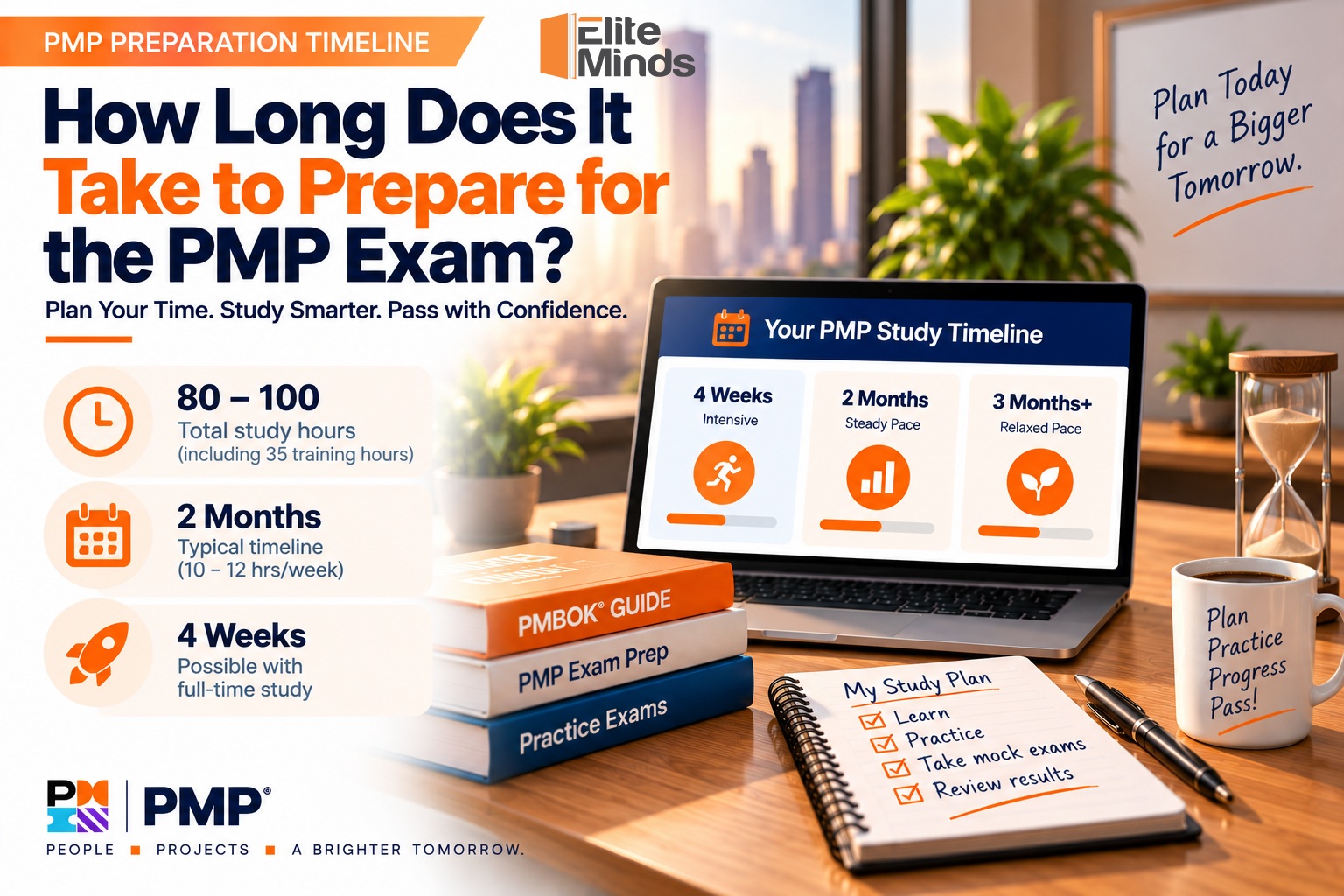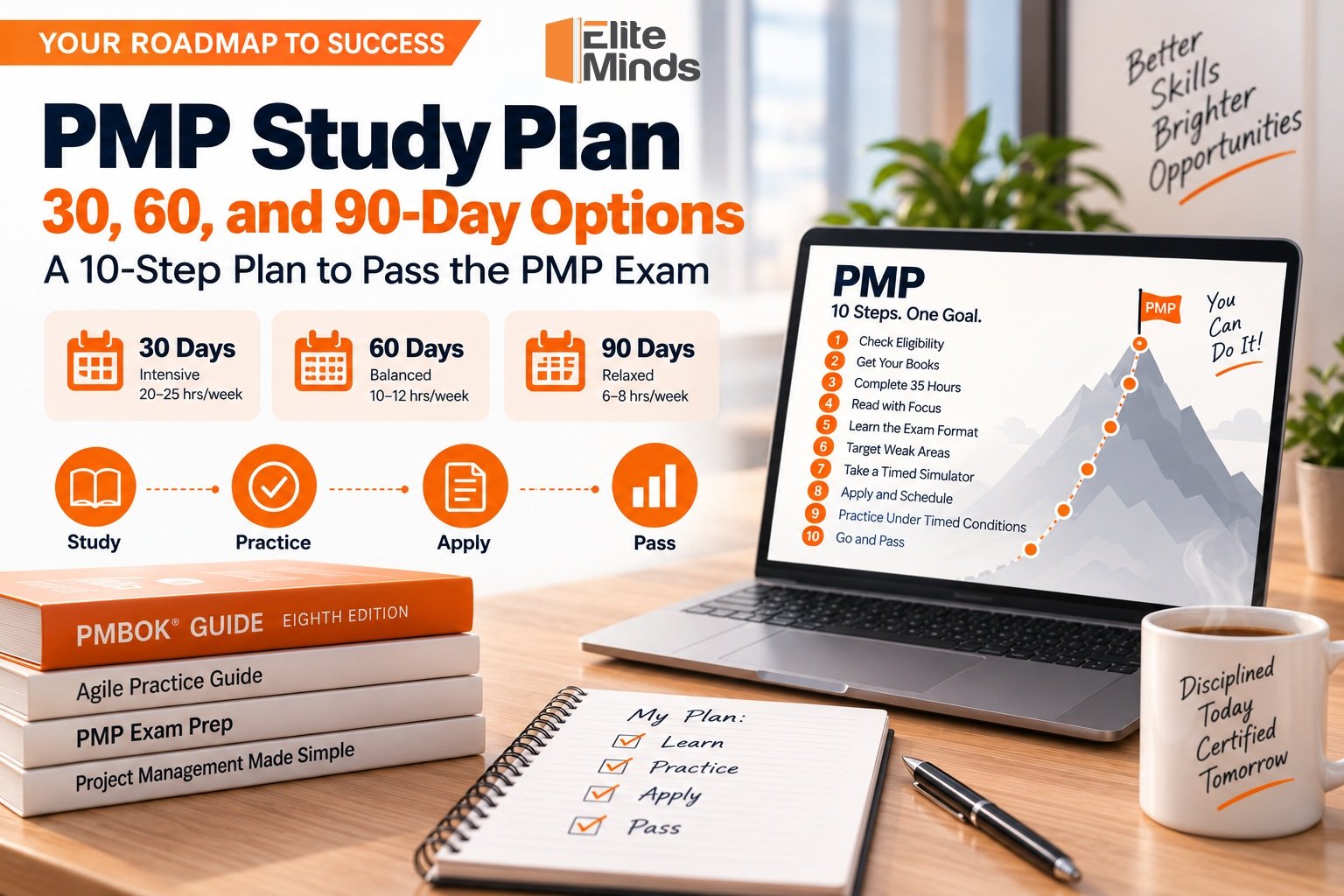
After guiding thousands of professionals through the PMP, the question I hear most is simply where to start. This PMP exam study plan answers that. It is a 10-step method built from my own exam preparation and years of coaching, and you can run it at three paces depending on how much time you can spare each week. The total effort is similar either way, roughly 80 to 100 hours. The three paces only change how you spread that work.
Choose your pace
Pick the pace that matches your weekly free time and your target exam date. The 30-day track is an intensive PMP preparation plan, the 60-day track is the balanced standard, and the 90-day track is a relaxed PMP learning plan for people with limited time each week.
| Pace | Length | Time per week | Best for |
|---|---|---|---|
| 30-day intensive | 4 weeks | 20 to 25 hours | A close exam date or full-time study availability |
| 60-day standard | 8 to 9 weeks | 10 to 12 hours | The balanced default for most working professionals |
| 90-day relaxed | 12 to 13 weeks | 6 to 8 hours | A busy schedule with limited weekly study time |
Start your application early. PMI approval, and a possible audit, can take anywhere from a few days to a few weeks. Submit your application near the start of whichever pace you choose, even though it appears as Step 8 in the method below. Do not wait until you are ready to book.
Your schedule at a glance
This table maps the ten steps of the PMP exam study plan onto each pace, so you can see roughly which week each step falls in.
| Step | 30-day | 60-day | 90-day |
|---|---|---|---|
| 1. Intent and eligibility | Week 1 | Week 1 | Week 1 |
| 2. Reference books and first read | Week 1 | Weeks 1 to 2 | Weeks 1 to 2 |
| 3. Complete the 35 contact hours | Weeks 1 to 2 | Weeks 3 to 4 | Weeks 3 to 5 |
| 4. Focused second read | Week 2 | Week 5 | Weeks 6 to 7 |
| 5. Exam structure and weighting | Week 2 | Week 5 | Week 7 |
| 6. Weak areas and hot topics | Week 3 | Week 6 | Weeks 8 to 9 |
| 7. First timed simulator | Week 3 | Week 7 | Week 10 |
| 8. Apply and schedule | Apply in Week 1 | Apply in Week 1 | Apply in Week 1 |
| 9. Timed practice | Weeks 3 to 4 | Week 8 | Weeks 11 to 12 |
| 10. Exam day | Week 4 | Week 9 | Week 13 |
The 10-step method
Step 1: Confirm your intent and check eligibility
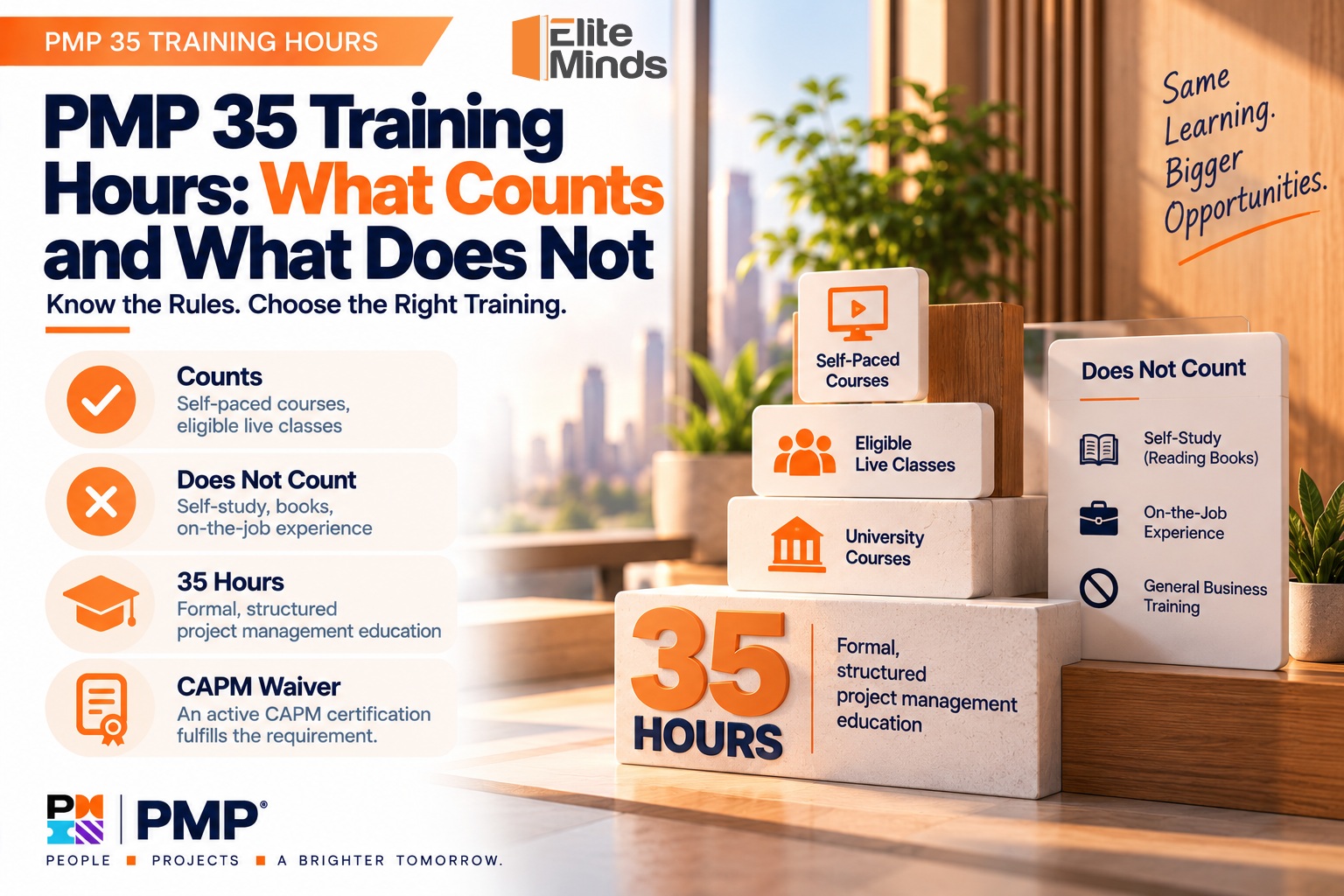
Every successful PMP study plan starts with real commitment, because you will need to protect study time for the weeks ahead. Before you invest, confirm you meet PMI's requirements: broadly, a four-year degree with 36 months of leading projects, or a high school diploma with 60 months, plus 35 contact hours of training, which is waived if you hold an active CAPM. All experience must fall within the last 10 years. Our PMP eligibility requirements 2026 guide covers the full criteria and the education tiers.
Step 2: Get your reference books
Before your 35-hour project management education course, read through your main reference at least once. A first pass gives you the shape of the material and shows you where your weak spots are, so you get far more out of the training. Use a current PMP prep guide aligned to the 2026 exam, together with the PMBOK Guide, Eighth Edition. Our PMP reference books guide lists current recommendations. This first read is the second step in your PMP study schedule.
Step 3: Complete the 35 contact hours
You need 35 contact hours of formal project management education to apply. There are three main options: live classroom training, interactive online webinars, or self-paced online training. Self-paced suits professionals who study well on their own and want maximum flexibility in their PMP learning plan. Our self-paced PMP exam prep course provides 35 contact hours of project management education and includes eight full practice exams. Whichever route you take, finish with the completion certificate you will need for your application.
Step 4: Read the prep material with focus
After the training, revisit your prep book with a sharper eye, concentrating on the areas the course revealed as weak. A second, careful read will bring you much closer to being ready for the exam. Bring in the PMBOK Guide, Eighth Edition here too. PMBOK 8 organizes project management into six principles and seven performance domains. This is important for the exam, because about 60% of the questions reflect agile and hybrid ways of working. Our PMP syllabus overview breaks down exactly what to study.
Step 5: Learn the exam structure and where the marks are
Knowing the structure tells you where to spend your time. The exam has 180 questions and a time limit of 240 minutes (4 hours). Questions are scored across three domains, People, Process, and Business Environment, weighted 33%, 41%, and 26% for the 2026 exam. About 60% of the questions reflect agile and hybrid approaches and the remaining 40% are predictive, spread across all three domains. For the full weighting and tasks, see our PMP Exam Content Outline (ECO) 2026 guide, and for timing, breaks, and question types, see our PMP exam format 2026 guide.
Step 6: Target your weak areas and the exam hot topics
With the structure clear, be honest about your gaps and give them extra time. Alongside your personal weak areas, study the high-priority areas of the 2026 exam. Our PMP exam hot topics guide covers the high-value areas to prioritize in your PMP preparation plan.
Step 7: Take your first timed simulator
Now test your readiness under real conditions. Our PMP exam simulator includes eight full-length tests of 180 questions, each timed to 240 minutes to match the real exam, for 1,440 practice questions in total. Sit the first test in a quiet room with only a simple calculator and scratch paper, and your phone switched off. Aim for 80% or higher. If you fall short, review your weak areas and take another test until you can reach that mark consistently.
Step 8: Apply for the exam and schedule your date
Submit your PMI application and, once it is approved, book your exam. The application covers your education, your project experience, and your 35 contact hours of project management education, and some applications are selected for audit. Because approval can take time, start this step early, as noted above. Our PMP eligibility requirements 2026 guide walks through the application and audit in detail. Book your date at least two weeks out, and remember you must pass within one year of your authorization.
Step 9: Practice under timed conditions
In my experience coaching candidates, time pressure is one of the most common reasons people fail on the first attempt. Completing 180 situational questions in 240 minutes is demanding. Build your stamina with full-length, timed practice exams under real conditions, aiming to finish all 180 within the limit while scoring 80% or more. This is the part of the PMP exam preparation plan that most separates confident candidates from anxious ones. You can check our high quality PMP exam simulators.
Step 10: Go and pass
The night before, rest well. On the day, eat properly and arrive at the test center at least an hour early. You will have a workstation with a simple on-screen calculator and materials for notes. Read the tutorial first. Check the clock only every 40 to 50 questions, and flag anything you are unsure of to revisit later within the same section, since you cannot return to a section once a break has started. When you finish, you will complete a short survey and then receive your result with a domain-by-domain breakdown.
Frequently asked questions
Yes. The 60-day and 90-day paces are designed for working professionals, at 10 to 12 or 6 to 8 hours a week. To estimate your own timeline, see How Long Does It Take to Prepare for the PMP Exam?.
Match it to your weekly free time and exam date. The 30-day plan suits full-time study or a close date, the 60-day plan is the balanced default, and the 90-day plan fits a busy schedule.
Enough to consistently score 80% or higher on full, timed 180-question tests. Our simulator provides 1,440 questions across eight exams.
Early. Approval and any audit can take days to weeks, so submit near the start of your plan rather than at the end.
A current, PMBOK 8-aligned resource plus agile and hybrid material, since about 60% of the exam reflects those approaches.