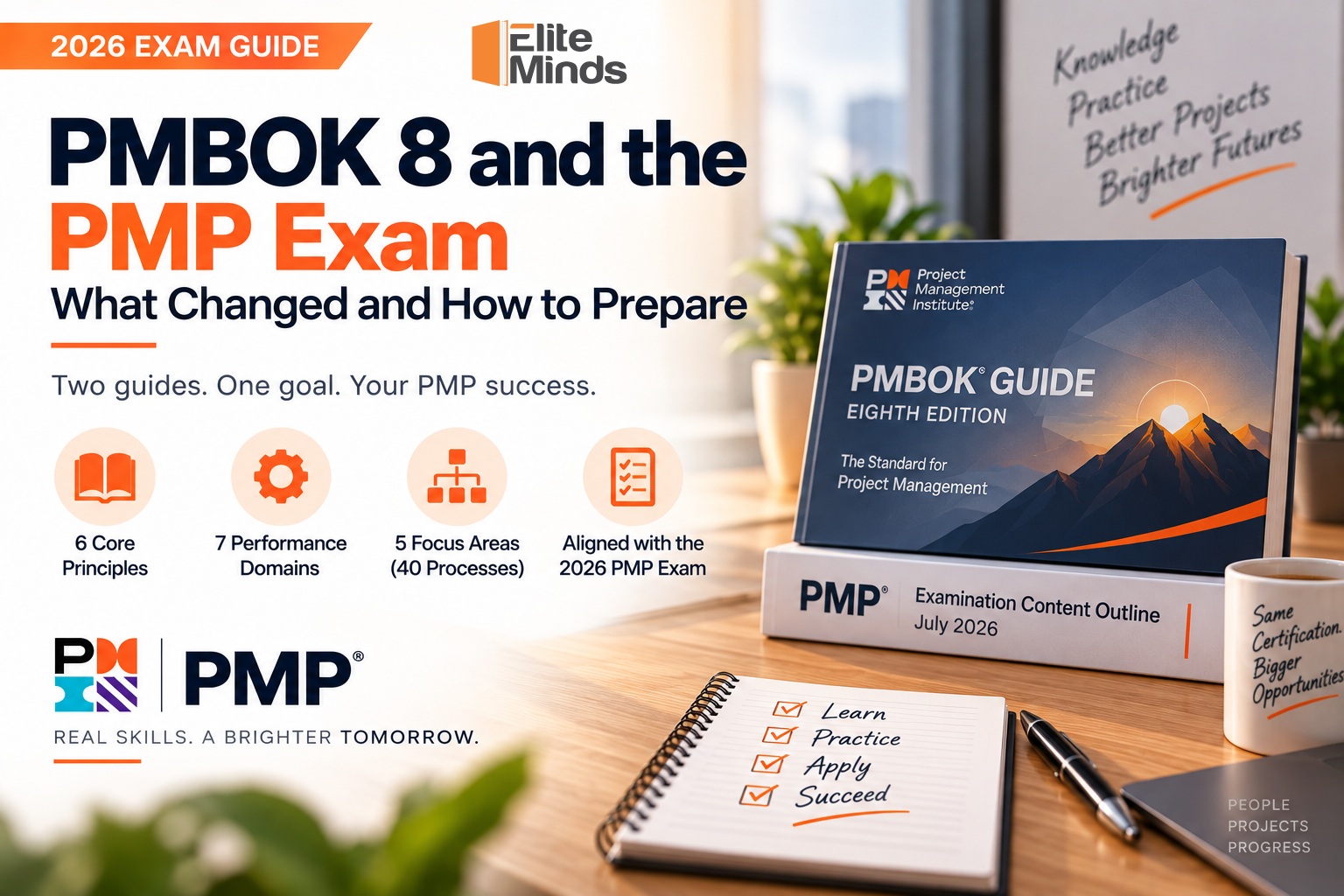
The PMP exam, from July 9, 2026, is written from the Examination Content Outline (ECO), not directly from the PMBOK Guide, Eighth Edition. Think about the new PMP ECO as the PMP exam blueprint. But PMBOK 8, published in November 2025, is the reference that explains the concepts behind ECO questions. Therefore, for your exam prep, the ECO and PMBOK 8 are your main reference guides. PMBOK 8 reorganizes project management around six core actionable principles, seven performance domains, and five focus areas holding 40 practical project management processes, a structural change from PMBOK 7's twelve principles and eight performance domains.
If you are preparing with the new edition, this PMBOK 8 PMP exam guide explains what changed between the editions and how the new guide fits into your preparation. For the full list of what to actually study, see our PMP Syllabus 2026 guide, and for the exam blueprint and domain weighting, see our PMP Exam Content Outline (ECO) 2026 guide.
PMBOK 8 vs the ECO: what is the difference?
These two documents get confused constantly, so it is worth being precise. The Examination Content Outline (ECO) is PMI's official exam blueprint. It defines the domains, tasks, and enablers that every exam question is written from, and how much each area is worth. The PMBOK Guide is a reference book that explains the concepts, principles, and practices behind those questions. PMI writes exam questions from the ECO, not directly from PMBOK chapters.
In practice, study the ECO to know what is tested and how much weight it carries, and study PMBOK 8 to understand the concepts well enough to answer scenario questions correctly. Neither replaces the other.
What changed from PMBOK 7 to PMBOK 8
| Element | PMBOK 7 (2021) | PMBOK 8 (November 2025) | Why it matters |
|---|---|---|---|
| Principles | 12 principles | 6 core principles | A more consolidated set of guiding principles, easier to apply consistently across scenario questions. |
| Performance domains | 8 performance domains | 7 performance domains | Domains were renamed and regrouped, not simply trimmed, so PMBOK 7 domain names will not all map across directly. |
| Focus areas | Not present | 5 focus areas holding 40 practical processes | PMBOK 8 restores concrete, practical process guidance that PMBOK 7 had moved away from. |
| Practical process detail | Principle-led, limited step-by-step guidance | 40 defined practical processes across the 5 focus areas | Candidates get more concrete how-to guidance than PMBOK 7 provided. |
| Publication date | 2021 | November 2025 | PMBOK 8 is the reference aligned with the July 2026 exam update. |
For how the 2021 and 2026 exams compare more broadly, not just the PMBOK reference, see our Old vs New PMP Exam (2021 vs 2026) guide.
The PMBOK 8 framework at a glance
This is a high-level orientation only. For the full study breakdown of what each principle, performance domain, and focus area covers, and how to study them.
Principles
PMBOK 8's six core principles are the foundational beliefs that should guide a project manager's decisions and behavior, regardless of methodology or industry. They sit above the performance domains and focus areas, acting as the why behind the practical guidance. An interesting fact in the PMBOK 8 is the introduction of the sustainability principle, explaining how sustainability should be seriously considered in every performance domain.
Performance domains
The seven performance domains group related project activities, the areas of focus a project manager actively manages throughout a project's life cycle. In PMBOK 8 they are Governance, Scope, Schedule, Finance, Stakeholders, Resources, and Risk. They describe interconnected areas of attention rather than sequential phases. For what each one covers and how to study it, see the PMP Syllabus 2026 guide.
Focus areas and practical processes
The five focus areas are new to PMBOK 8. Each holds a set of the 40 practical processes, giving candidates the concrete, step-by-step guidance that PMBOK 7's principles-only model lacked. This is the biggest structural addition in the new edition. The five focus areas were foremary named as process groups in the PMBOK 6.
How PMBOK 8 supports exam preparation
Because exam questions are written from the ECO, memorizing PMBOK 8 page by page will not, by itself, prepare you for the exam. What matters is understanding the concepts well enough to apply them in realistic, scenario-based questions. Use PMBOK 8 to build that conceptual understanding, then practice applying it against ECO-aligned mock questions. The two activities work together, not separately.
Do you need to buy PMBOK 8?
| Your current study base | Recommendation |
|---|---|
| PMBOK 6th edition or earlier | Replace |
| PMBOK 7th edition | Supplement with PMBOK 8 changes, or replace if budget allows |
| No PMBOK guide yet | Optional. A PMBOK 8-aligned course or the Syllabus 2026 guide may cover what you need |
| A course or simulator you already own | Confirm it explicitly states PMBOK 8 alignment before relying on it |
Common mistakes when studying PMBOK 8 for the exam
- Assuming the ECO and PMBOK are the same document. They serve different purposes.
- Studying PMBOK 6 or 7 content without checking it against PMBOK 8's structure. I personally don't recommend, just get the PMBOK 8, if you are a PMI member, you can download it for free from their website.
- Memorizing every principle and process by name instead of understanding how they apply in scenarios.
- Treating PMBOK 8 as optional because the ECO is what is tested. Skipping it removes essential conceptual context.
- Assuming PMBOK 8 alone is sufficient preparation without practicing against an updated simulator.
Conclusion
PMBOK 8 is the main study reference behind the July 2026 PMP exam, not the exam blueprint itself, which is still the ECO. The edition consolidated its principles from twelve to six, streamlined performance domains from eight to seven, and added five focus areas holding 40 practical processes that restore the concrete guidance PMBOK 7 had moved away from. Use it to build conceptual understanding, then apply that understanding against ECO-aligned practice questions.
For the full study breakdown, see PMP Syllabus 2026. For a study timeline, see our PMP Study Plan. For structured preparation, see our PMP Exam Prep Course.
Frequently asked questions
November 2025.
No. PMBOK 8 is a study reference. The Examination Content Outline (ECO) is the blueprint PMI writes exam questions from.
Six core principles, down from twelve in PMBOK 7.
Seven interconnected areas a project manager actively manages: Governance, Scope, Schedule, Finance, Stakeholders, Resources, and Risk. See our PMP Syllabus 2026 guide for the full breakdown of each.
Not strictly. See the comparison table above. A PMBOK 8-aligned course or the Syllabus 2026 guide can cover the concepts you need.
Partially. Core principles and the performance-domain model carry over conceptually, but PMBOK 8's focus areas and practical processes are new.
Yes. Materials still built around the ten knowledge areas or five process groups are outdated under both PMBOK 7 and PMBOK 8.
See our PMP Syllabus 2026 guide.
See our PMP Exam Content Outline (ECO) 2026 guide.
It touches on them as part of modern project practice, but full exam-scenario coverage lives in our dedicated AI Topics and Sustainability Questions guides.


 Side-by-Side Comparison.jpg)