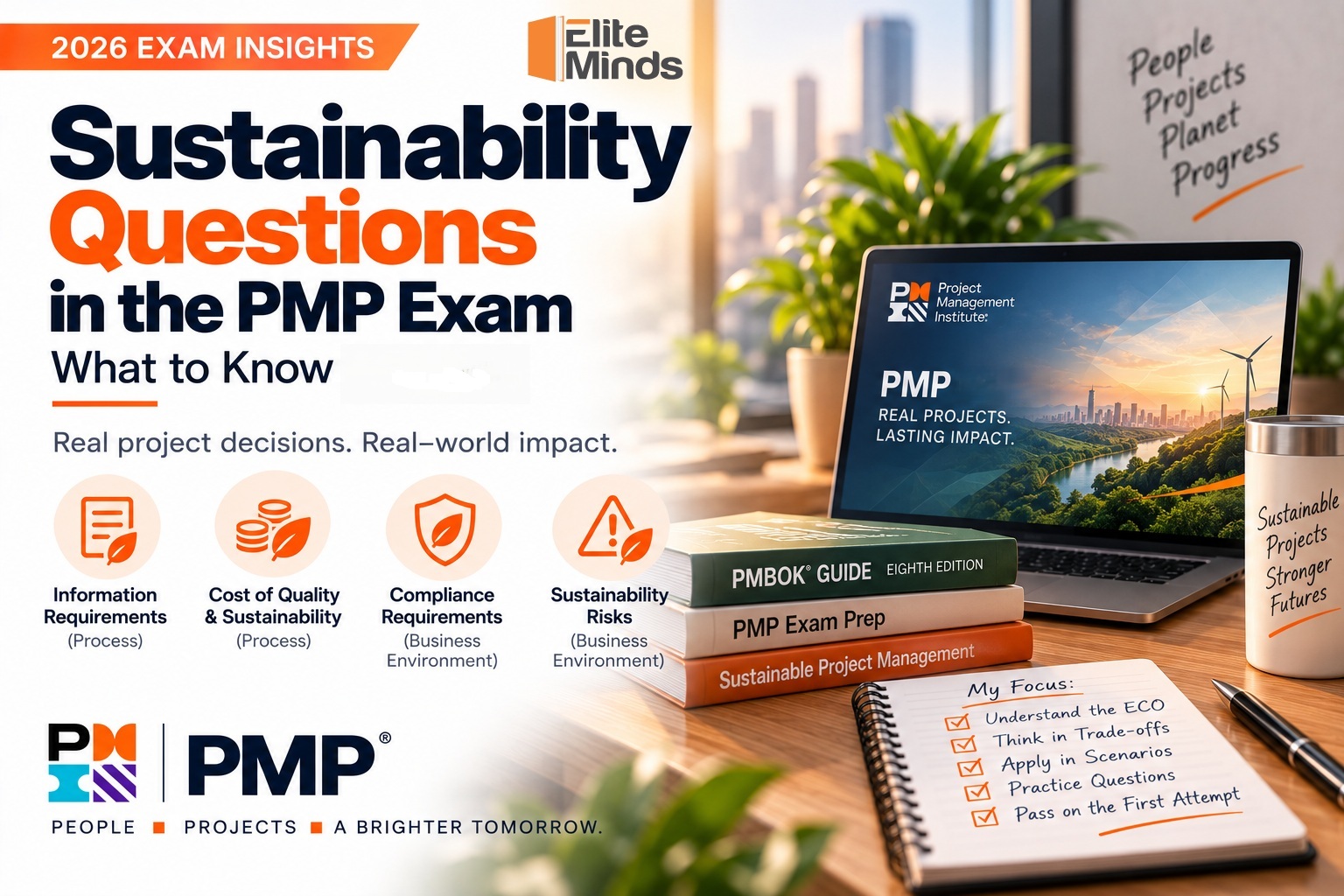
Since July 9, 2026, sustainability is part of PMI's official PMP exam outline. It is not a domain or a task of its own. Instead, it appears in four enablers: two in the Process domain and two in the Business Environment domain. These cover information requirements, cost of quality, compliance, and risk.
PMI does not test environmental science, specific laws, or sustainability certifications. It tests your judgment as a project manager: can you weigh environmental and social impact together with cost, schedule, scope, quality, and risk, and make a sound decision when these priorities conflict? This sustainability PMP exam guide explains where sustainability appears, how it shows up in scenarios, and how to prepare.
For a quick overview of what sustainability means for the 2026 PMP exam, watch this short video on what PMI now expects candidates to understand.
PMP 2026 sustainability at a glance
What the ECO actually says. Sustainability is named in four enablers of the 2026 Examination Content Outline. Enablers are PMI's illustrative examples of the work in each task. They are not a complete list, and you do not need to memorize them. They show where PMI expects sustainability to be part of a project manager's normal work.
| Domain | ECO enabler (PMI wording) | What it can mean in a scenario |
|---|---|---|
| Process | Determine critical information requirements (e.g., sustainability) | Stakeholders may need sustainability information reported, such as energy use or waste, so you plan for collecting and sharing it. |
| Process | Manage cost of quality (CoQ) and sustainability | Quality decisions include sustainability. A cheaper option today may cost more in rework, waste, or failures later. |
| Business Environment | Compliance requirements, with sustainability listed alongside security, health and safety, and regulatory compliance | You identify the sustainability rules and policies that apply to the project and make sure the project meets them. |
| Business Environment | Execute a risk management plan (e.g., managing sustainability risks) | You identify sustainability risks, such as a supplier's environmental practices, and plan and carry out responses. |
For the full domain weighting and every task, see our PMP ECO guide.
Why sustainability is now part of the exam
PMI updates the exam based on a Job Task Analysis, which is research into what practicing project managers actually do. Sustainability was one of the trends PMI studied for the 2026 update, because more organizations now expect projects to account for their environmental and social impact. It is also one of the six core principles in the PMBOK Guide, Eighth Edition, which asks project managers to integrate sustainability across all areas of the project. See our PMBOK 8 and the PMP Exam guide for the principles, and our New PMP Exam guide for everything else that changed.
PMP exam sustainability scenarios: what to expect
Questions that involve sustainability are situational, like the rest of the PMP. You read a project scenario and choose what a competent project manager should do. The sustainable project management PMP candidates need is practical, not technical. The themes below show the kind of judgment these scenarios are likely to test.
Balancing sustainability with cost, schedule, and scope
A more sustainable option often costs more, takes longer, or changes scope. The exam does not reward choosing the cheapest option every time, and it does not reward choosing the most sustainable option every time. It rewards a reasoned decision, based on the project's objectives and what stakeholders expect.
Illustrative example. One supplier offers the lowest price and the fastest delivery. Another has stronger environmental practices but needs more time. A good first step is to assess both options against the project's objectives and stakeholder expectations, rather than choosing either supplier immediately.
Sustainability can act as a project constraint that influences supplier selection, cost, schedule, and delivery decisions. This video explores sustainability through an ESG and PMBOK Guide Eighth Edition perspective.
Thinking about the full lifecycle
This links directly to the cost of quality enabler. Some decisions cost more at the start but reduce maintenance, waste, or rework later. Ask yourself: what does this decision cost over the whole life of the deliverable, not only in this phase?
Illustrative example. A more durable component costs more and would exceed the current phase budget, but it would reduce maintenance for years. A strong response is to present the long-term trade-off to the right decision-maker, rather than quietly choosing the cheaper part to stay within budget.
Meeting compliance requirements
Sustainability is now listed as a compliance category in the outline. In a PMP scenario, you may need to identify which sustainability requirements apply to the project, such as an organizational policy or a sector rule, and make sure the project meets them. You are not expected to know a specific country's laws. You are expected to know how to find, plan for, and manage compliance requirements.
Managing sustainability risks
Risk scenarios can include sustainability. For example, a key supplier could face penalties for environmental violations, which could delay deliveries. The project manager is expected to identify the risk, assess it, and plan a response, using the same risk management approach as for any other risk.
Reporting the right information
Under the information requirements enabler, some stakeholders may need sustainability data, such as energy use, waste, or materials sourcing. The key point is to identify these needs early and include them in your communication planning, instead of discovering them at the end of the project.
Social impact and honest communication
Sustainability is not only about the environment. Following the PMBOK 8 principle, it also includes social impact, such as working conditions, effects on the local community, and ethical sourcing. When stakeholders have different expectations, the expected behavior is to explain trade-offs honestly, without exaggerating how sustainable the project is.
What PMI does not test
- Specific environmental laws or regulations of any country. You do need to know how to manage compliance requirements in general.
- Sustainability certifications, reporting standards, or frameworks.
- Environmental science or technical calculations. This is a project management exam.
- One fixed ethical position. Scenarios test your judgment and process.
If a practice question expects you to know a particular regulation or certification scheme, it does not represent the real exam.
How to prepare
- Learn where sustainability appears in the outline: information requirements, cost of quality, compliance, and risk.
- Think in trade-offs. Compare sustainability with cost, schedule, scope, and quality instead of treating it as an automatic first priority.
- Look at the full lifecycle of a decision, not only the current phase budget.
- When stakeholders disagree, look for the answer that communicates the trade-off and involves the right decision-maker.
- Practice with a simulator updated for the 2026 exam, so you see sustainability inside realistic scenarios.
Common mistakes
- Treating sustainability as a separate topic to memorize instead of a consideration inside normal decisions.
- Assuming the most sustainable answer is always correct.
- Ignoring sustainability in compliance and risk questions, where the outline names it directly.
- Judging a decision only by its upfront cost.
- Studying environmental regulations or certifications that the exam does not test.
Your next step
Sustainability is one of several areas the 2026 exam emphasizes. See our PMP Exam Hot Topics guide for the others, and our AI Topics in the PMP Exam guide for how AI appears in scenarios.
To practice, take a free PMP practice test. For structured preparation, see our PMP Exam Prep Course.
Frequently asked questions
Yes. Sustainability is named in four enablers of the 2026 Examination Content Outline: critical information requirements and cost of quality in the Process domain, and compliance and risk management in the Business Environment domain.
No. Sustainability is not a domain or a task. It appears inside tasks in the Process and Business Environment domains, as part of normal project decisions.
PMI does not publish a percentage for sustainability. It appears as part of scenarios within the existing domain weighting: People 33%, Process 41%, and Business Environment 26%.
No. The exam tests project management judgment, not scientific or technical environmental knowledge.
No specific laws are tested. You do need to know how to identify and manage compliance requirements, and sustainability is one of the compliance categories in the outline.
They include the environmental impact of materials, energy, waste, and suppliers, weighed together with cost, schedule, scope, quality, and risk.
No. Following the PMBOK 8 sustainability principle, it also includes social impact, such as working conditions, community effects, and ethical sourcing.
No. The scenarios test general judgment. Understanding the four areas in this guide and practicing scenario questions is enough.