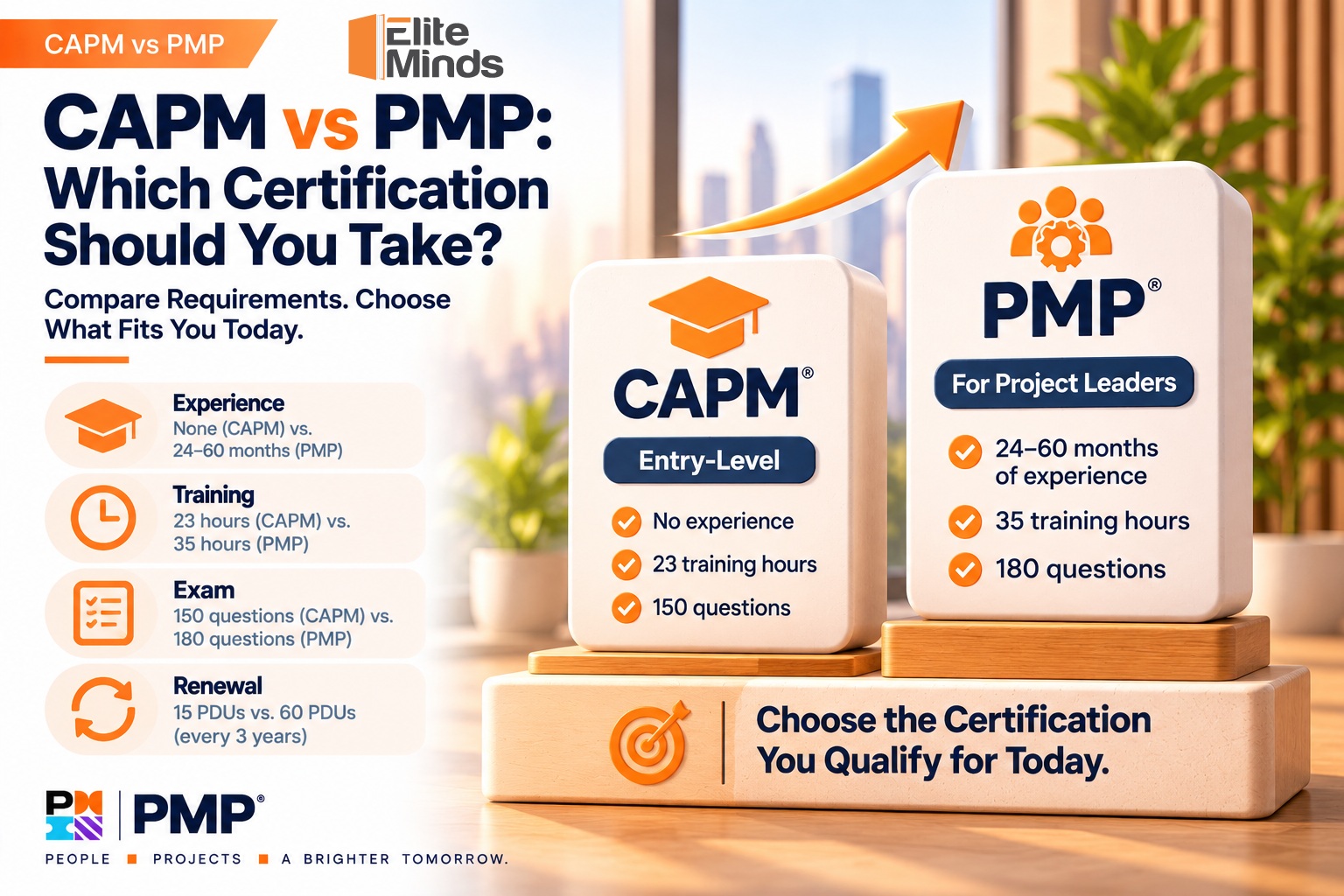
The CAPM is for people starting a project management career, and the PMP is for people who have already led projects. The CAPM needs no work experience, only a secondary diploma and 23 hours of project management education. The PMP needs 24 to 60 months of experience leading projects, depending on your education, plus 35 hours of project management training. So the real question is not which certification is better. It is which one you qualify for today.
When professionals ask me where to start, I ask them one question first: how many months have you spent leading projects in the last 10 years? The answer usually decides it. This guide compares both certifications for 2026 and helps you choose.
CAPM vs PMP at a glance
Here is the CAPM certification vs PMP comparison in one table.
| CAPM | PMP | |
|---|---|---|
| Who it is for | Students, graduates, career changers, team members | Professionals who already lead projects |
| Work experience | None required | 24 to 60 months leading projects, within the last 10 years |
| Education | Secondary diploma or equivalent | Depends on the route: secondary diploma, associate degree, bachelor's degree, or GAC-accredited degree |
| Training | 23 contact hours | 35 contact hours, or an active CAPM |
| Exam | 150 questions in 180 minutes | 180 questions in 240 minutes |
| Exam content | Fundamentals, predictive, agile, and business analysis | People, Process, and Business Environment, across predictive, agile, and hybrid |
| Current exam outline | 2023 (in effect since July 2023) | July 2026 |
| Exam fee (US) | $225 member / $300 non-member | $445 member / $675 non-member |
| Renewal | 15 PDUs every 3 years | 60 PDUs every 3 years |
| What it proves | You know the concepts and terminology | You can lead projects and apply judgment |
Confirm the current fees on PMI.org before you pay, because they change from time to time and differ by country.
What is the CAPM?
The Certified Associate in Project Management (CAPM) is PMI's entry-level certification. It shows that you understand the basic concepts, terms, and ways of working that project teams use, even if you have not led a project yet.
A simple way to think about it: the CAPM tests what you know, while the PMP tests what you would do as a project manager.
The CAPM is a good fit if you are:
- A student or recent graduate
- Moving into project management from another field
- A project coordinator or team member who wants to understand the bigger picture
- Planning to take the PMP later, but not yet eligible
What is the PMP?
The Project Management Professional (PMP) is PMI's flagship certification for people who lead projects. It is built around real situations: you read a scenario and choose what an experienced project manager should do next. Since July 9, 2026, the exam follows a new outline, with more weight on the Business Environment domain and on agile and hybrid approaches. Our New PMP Exam guide explains what changed.
Eligibility: the biggest difference
This is where most people find their answer.
CAPM requirements:
- A secondary diploma (high school or global equivalent)
- 23 contact hours of project management education, completed before the exam
No work experience is needed.
PMP requirements: you need experience leading projects, and the amount depends on your education. All of it must fall within the last 10 years.
| Education | Experience leading projects |
|---|---|
| Secondary diploma | 60 months |
| Associate's degree or equivalent | 48 months |
| Bachelor's degree | 36 months |
| Degree from a GAC-accredited program | 24 months |
You also need 35 contact hours of project management education. If you hold an active CAPM, it fulfills this 35-hour requirement. It does not reduce the experience you need. For the full rules, see our PMP Eligibility Requirements guide.
The difference between CAPM and PMP exams
| CAPM | PMP | |
|---|---|---|
| Questions | 150 (135 scored, 15 unscored) | 180 (170 scored, 10 unscored) |
| Time | 180 minutes | 240 minutes |
| Breaks | One optional 10-minute break | Two optional 10-minute breaks |
| Question style | Mostly knowledge and understanding | Mostly situational, including case-study sets |
The CAPM exam has four domains:
- Project Management Fundamentals and Core Concepts (36%)
- Business Analysis Frameworks (27%)
- Agile Frameworks and Methodologies (20%)
- Predictive, Plan-Based Methodologies (17%)
The PMP exam has three domains: People (33%), Process (41%), and Business Environment (26%). About 60% of PMP questions reflect agile and hybrid approaches. For timing, breaks, and question types, see our PMP Exam Format guide.
The key point is the style, not only the length. A CAPM question may ask what a risk register is. A PMP question describes a project where a new risk appears and asks what you should do first.
Which exam is harder?
The PMP is harder for most people. It is longer, and it expects you to apply judgment in situations you would only understand from real project work. The CAPM is closer to a knowledge test.
PMI does not publish official pass rates for either exam, so be careful with any exact pass percentage you see online.
Cost compared
| Fee (US) | CAPM | PMP |
|---|---|---|
| Exam, PMI member | $225 | $445 |
| Exam, non-member | $300 | $675 |
| Required training | 23 hours | 35 hours |
PMI membership lowers the exam fee for both certifications, but it does not always lower your total cost. For the CAPM, the member discount is $75, which is less than the yearly membership fee. So on a single CAPM attempt, membership usually costs more than it saves. For the PMP, the member discount is $230, which is larger than the membership fee, so membership usually pays for itself.
For the full PMP budget, including retakes and renewal, see our PMP Exam Cost guide.
Renewal
Both certifications are valid for three years.
- CAPM: earn 15 Professional Development Units (PDUs) every three years.
- PMP: earn 60 PDUs every three years.
Many candidates let their CAPM expire once they earn the PMP, because the PMP covers the same ground at a higher level. Keeping both is a personal choice.
Career value
The CAPM helps you get into project work. It shows employers that you understand the language and methods of project management, which is useful when you apply for coordinator, junior project manager, or PMO analyst roles.
The PMP helps you move up. It is widely requested for project manager, senior project manager, and program roles. PMI's latest salary survey reports that PMP holders earn a 17% higher median salary than non-certified peers, and 24% higher in the United States. See our PMP Certification Benefits guide for more.
CAPM or PMP: which should you take first?
Ask yourself these three questions, in this order.
1. Do you meet the PMP experience requirement today? Count only the months you spent leading and directing project work in the last 10 years, without double-counting overlapping projects. If you meet your route's number, go straight to the PMP. Taking the CAPM first will not help you much.
2. Will you meet it within the next 12 to 18 months? If yes, you can still go straight to the PMP. Start studying now and apply once you qualify. The CAPM would cost you time and money for a credential you will soon replace.
3. Are you further away than that? Then the CAPM is the better first step. It gives you a recognized credential now, teaches you the vocabulary employers expect, and its active status covers the 35-hour training requirement when you apply for the PMP later.
| Your situation | Our recommendation |
|---|---|
| Student or fresh graduate | CAPM |
| Career changer with little project experience | CAPM |
| Coordinator with 1 to 2 years of project work | CAPM now, or wait for the PMP if you are close |
| Bachelor's degree and 36+ months leading projects | PMP |
| Experienced project manager without a degree | PMP, through the 60-month route |
| Already a manager, but not in a project role | Count your project experience first, then decide |
Moving from CAPM to PMP
If you start with the CAPM, the path to the PMP is straightforward:
- Pass the CAPM and keep it active.
- Take on project work where you lead and direct activities, and record the dates, your role, and what you delivered.
- Once you reach your experience requirement, apply for the PMP. Your active CAPM fulfills the 35-hour training requirement.
- Prepare for the 2026 PMP exam. It tests judgment, not only knowledge, so plan for timed scenario practice.
A common mistake is to assume the CAPM study material is enough for the PMP. It is not. The PMP covers leadership, business environment, and hybrid delivery in much more depth, and its questions are situational.
Your next step
Start by checking where you stand. Our PMP Eligibility Requirements guide shows exactly how many months you need for your education level.
- If you qualify for the PMP, our PMP Exam Prep Course includes the 35 training hours, eight full mock exams, and application support.
- If you are starting out, our CAPM Exam Prep Course includes the 23 contact hours you need to apply.
Frequently asked questions
The CAPM is an entry-level certification that needs no project experience and tests knowledge. The PMP is for experienced project managers. It needs 24 to 60 months of experience leading projects and tests how you would act in realistic situations.
Take the PMP first if you already meet its experience requirement, or will within 12 to 18 months. Otherwise, the CAPM is a good first step, and it covers the PMP's 35-hour training requirement later.
Yes, for most people. The CAPM is shorter and tests knowledge and understanding. The PMP is longer and tests how you would act in realistic project situations.
Yes. The CAPM is not a requirement for the PMP. If you meet the PMP experience requirement, you can apply directly.
An active CAPM fulfills the PMP's 35-hour training requirement. It does not count toward the months of project experience.
No. You need a secondary diploma and 23 contact hours of project management education.
No. The July 2026 update applies to the PMP. The CAPM still follows the outline that took effect in July 2023, with the four domains listed above.
The CAPM helps you start a project management career. The PMP helps you advance in one. Choose based on the experience you have today.
Both are valid for three years. The CAPM needs 15 PDUs to renew, and the PMP needs 60.