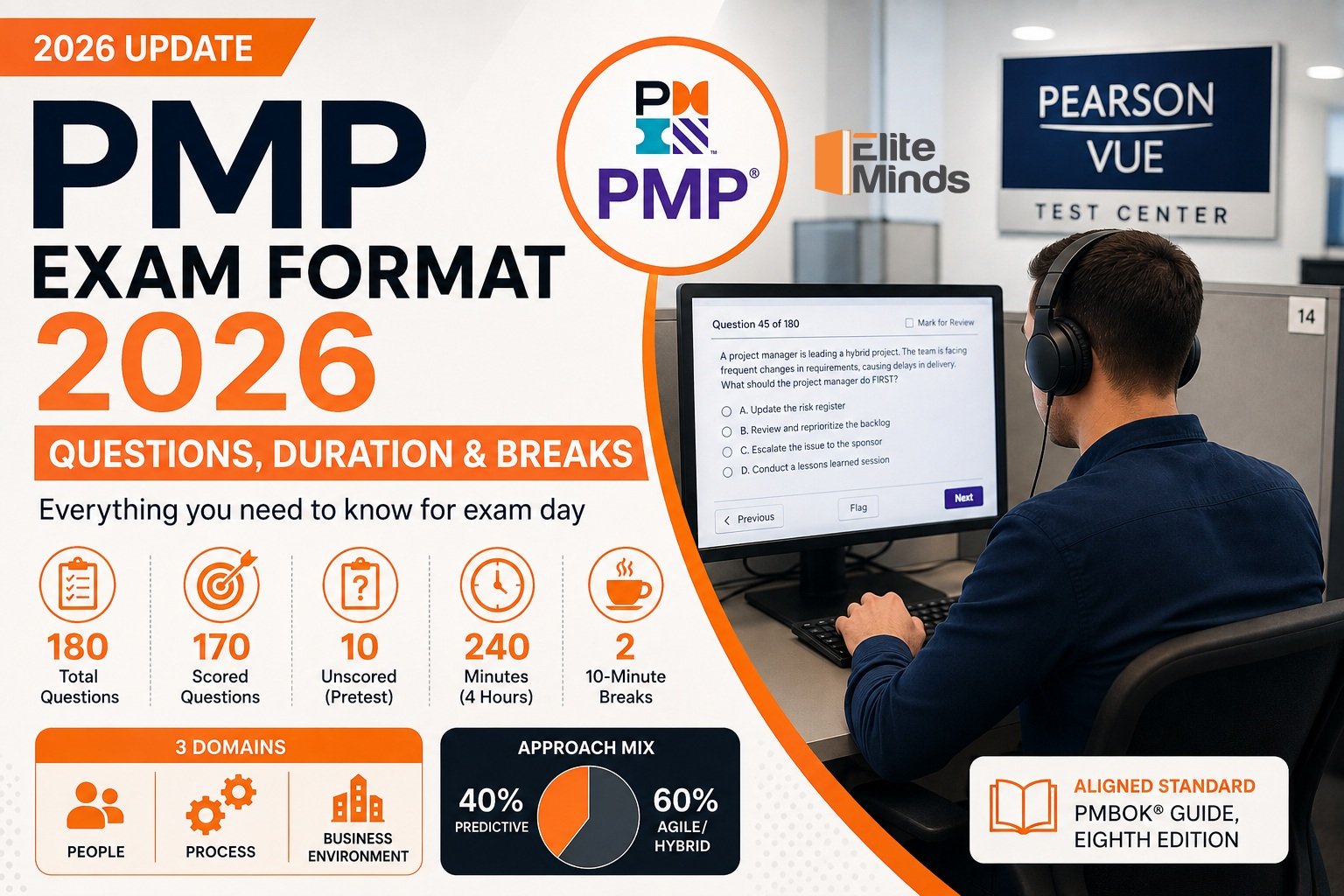
Since July 9, 2026, the PMP® exam has 180 questions and gives you 240 minutes (4 hours) to answer them, with two 10-minute breaks. Of those 180 questions, 170 are scored and 10 are unscored pretest questions you can't tell apart from the rest. The questions cover three domains: People, Process, and Business Environment, and mix predictive, agile, and hybrid approaches, with a heavy Agile focus this time: about 60% of questions relate to agile and hybrid development lifecycles. This guide walks through the format, the question types, the breaks, and what to expect on exam day.
Looking for what changed in July 2026 rather than the format itself? See our complete guide to the new 2026 PMP exam. For how the exam is weighted across domains, see the PMP Exam Content Outline (ECO) 2026.
The Project Management Professional (PMP)® certification is one of the most respected credentials in project management. Passing on your first attempt is far easier when you know how the exam is built: how long it runs, how many questions you'll face, what those questions look like, and when your breaks fall. Once you understand the format, you can plan your pacing and avoid surprises on the day.
PMP exam format at a glance
| Element | Current exam (from July 9, 2026) |
|---|---|
| Total questions | 180 |
| Scored questions | 170 |
| Unscored (pretest) questions | 10 |
| Time allowed | 240 minutes (4 hours) |
| Breaks | Two 10-minute breaks (timer pauses) |
| Domains | People, Process, Business Environment |
| Approach mix | About 40% predictive, 60% agile/hybrid |
| Aligned standard | PMBOK® Guide, Eighth Edition |
The 10 pretest questions are unscored items PMI uses to trial future questions. They're placed at random and look exactly like the scored ones, so treat every question as if it counts, you have no way of knowing which is which.
Note on the older format: Anyone who tested before July 9, 2026 sat a 230-minute version with 175 scored and 5 unscored questions. That version has now been retired completely, with no overlap period, so everyone testing today takes the 240-minute format described here.
PMP exam question types and formats
The 2026 exam uses several question formats, built to test how you apply project management judgment rather than how much you can memorize:
- Case or scenario set (new for 2026): an extended, multi-paragraph case study followed by 3–5 linked questions.
- Visual-based (new for 2026): a question built around visuals such as information radiators and dashboards.
- Multiple choice: select the best option from four choices.
- Multiple responses: more than one correct answer may exist; the question tells you how many to select (usually 2–3).
- Drag and drop: match choices presented in two columns.
- Hotspot: select a portion of a diagram to mark the correct answer.
- Pull-down list (fill in the blank): choose the correct answer from a drop-down list.
Most questions are situational. You're given a realistic project scenario and asked to choose the best course of action. Often more than one option looks reasonable, so your job is to pick the answer that fits sound project management practice whether the scenario is predictive, agile, or hybrid.
What the exam covers: the three domains
The exam is organized into three performance domains:
- People: leading and building the project team.
- Process: the technical side of running the project.
- Business Environment: connecting the project to organizational strategy, value, and compliance.
The share of the exam each domain carries changed with the 2026 update, and Business Environment grew the most. Domain weighting belongs to the exam blueprint rather than the format, so we cover the full breakdown: domains, tasks, enablers, and the new percentages, in our dedicated PMP Exam Content Outline (ECO) 2026 guide. Predictive, agile, and hybrid approaches run through all three domains and aren't limited to any single one.
PMP exam structure, breaks and timing
The exam gives you two 10-minute breaks. The first break prompt appears after you complete the initial interactive/case-study section, and the second occurs midway through the independent question blocks. The countdown timer pauses while you're on a scheduled break, so breaks don't come out of your 240 minutes of answering time. You can take them or skip them as you prefer.
As a rough pacing guide, 180 questions in 240 minutes works out to about 80 seconds per question. Try not to watch the clock the whole time, check it every 40 to 50 questions instead. If a question is dragging, mark it for review, move on, and come back later.
What to expect on exam day
- Get a good night's sleep, eat something that keeps your energy up, and arrive at the test center at least an hour early.
- You'll get a workstation with a basic on-screen calculator, plus note-taking materials the center allows.
- Read the on-screen tutorial first, it confirms the format and shows you how to flag questions.
- For scenario questions, trust your preparation. If you're unsure, flag it and keep moving instead of losing time.
- When you finish, you'll complete a short survey about the test center, then get your result with a domain-by-domain report rated Above Target, Target, Below Target, or Needs Improvement.
PMI does not publish an official pass rate or passing score, so be careful with any exact "pass percentage" you find online. What you can control is solid, exam-focused preparation.
How to prepare for the 2026 format
- Study a current, PMBOK 8-aligned resource so you understand the principles, performance domains, and focus areas behind the questions. Our PMP syllabus overview is a good place to start.
- Practice with a 2026-updated PMP exam simulator so the timing and question formats feel familiar. You can begin with a free PMP practice test.
- Complete the required 35 contact hours through a structured PMP exam prep course.
- Build a realistic PMP study plan around the time you have and your target exam date.
- For fees, membership, and application costs, see our PMP exam cost guide, and always confirm the current figure on PMI.org before you pay.
Frequently asked questions
180 questions in total, 170 scored and 10 unscored pretest questions.
240 minutes (4 hours), effective from July 9, 2026.
Two 10-minute breaks. The first prompt appears after the initial interactive/case-study section, and the second occurs midway through the independent question blocks. The exam timer pauses during each break.
Case-study scenario sets, multiple choice, multiple response, matching (drag and drop), hotspot/graphic, and limited fill-in-the-blank (pull-down) questions.
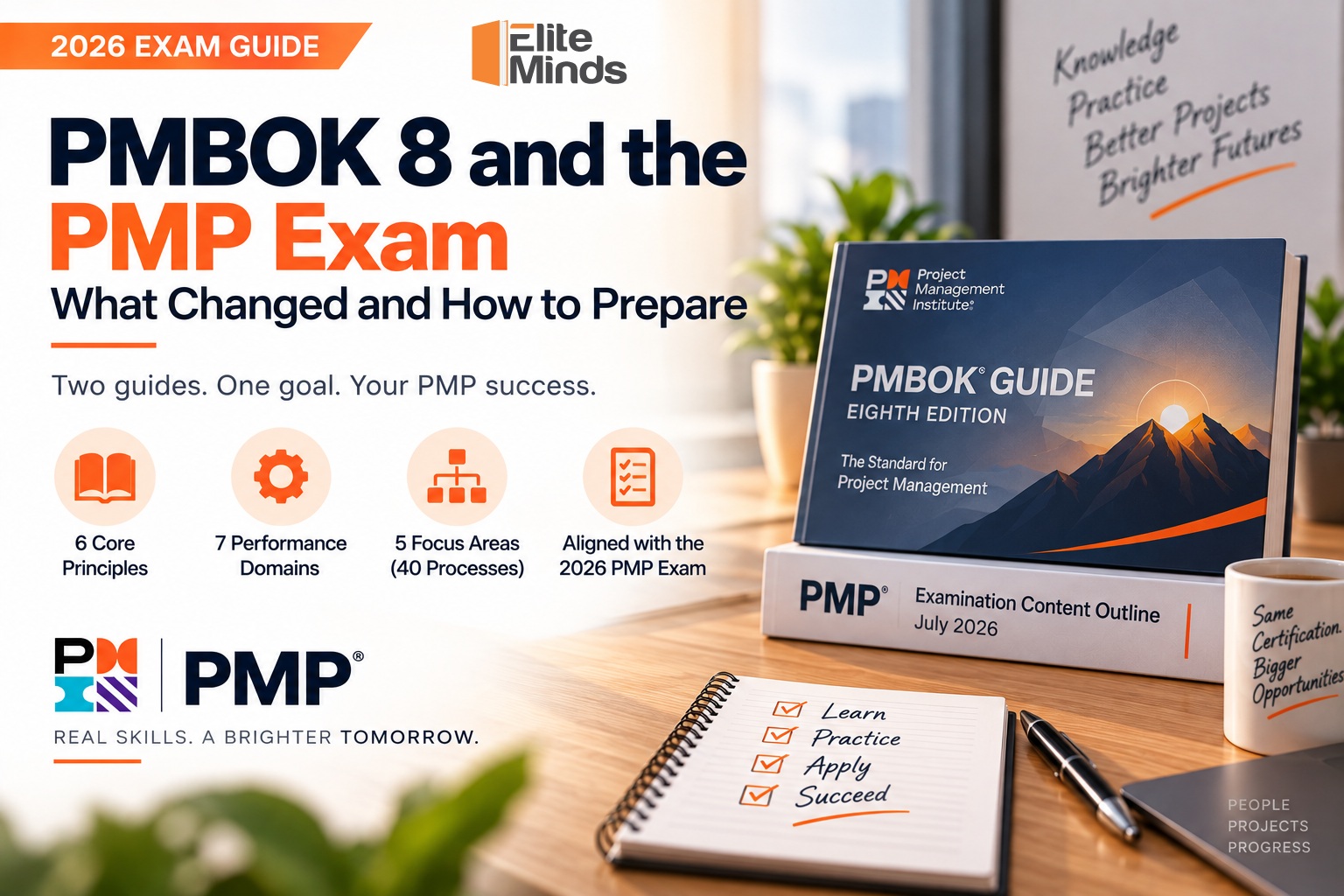
The PMBOK® Guide, Eighth Edition, published in November 2025, together with the latest PMP Exam Content Outline.


 Side-by-Side Comparison.jpg)